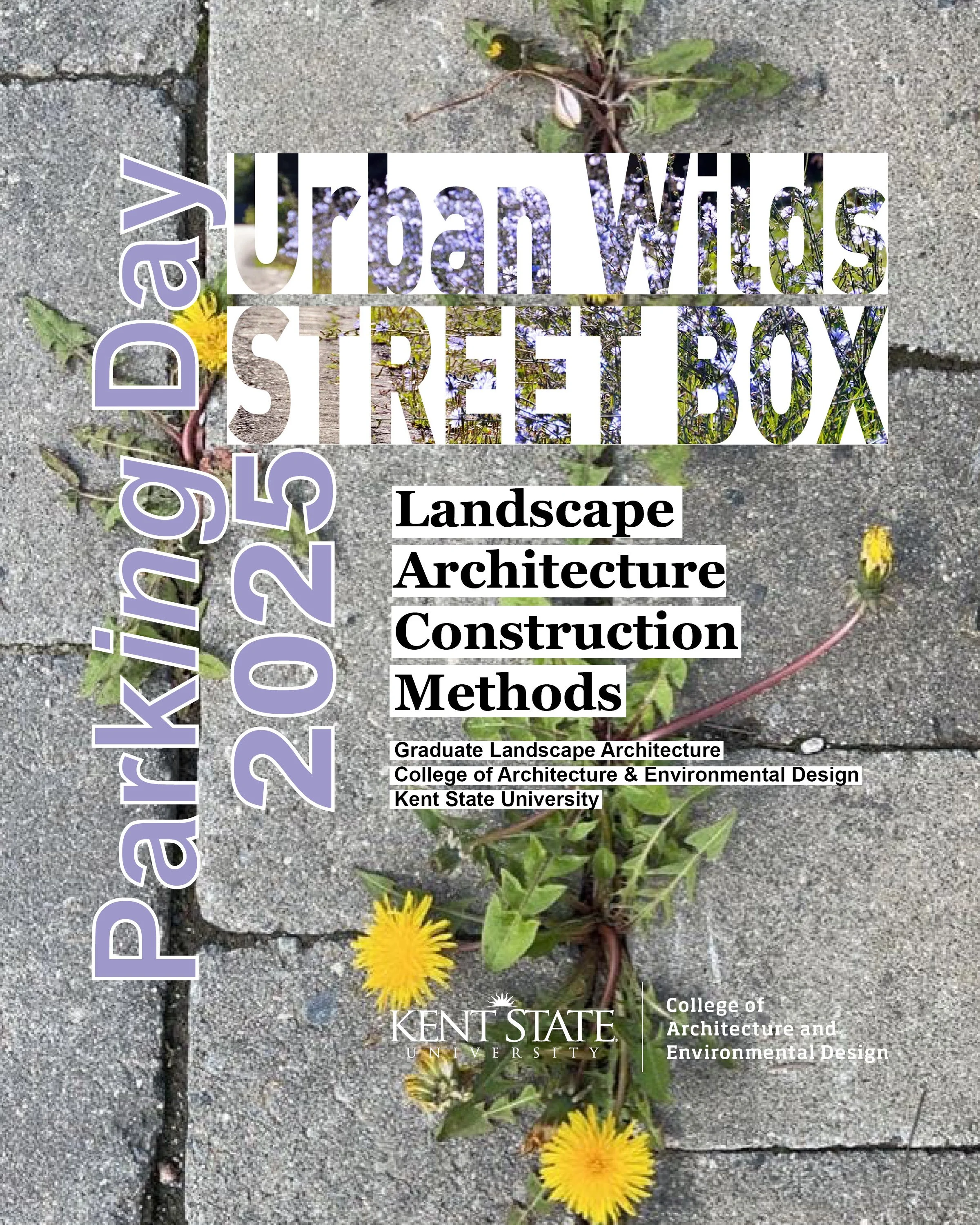
KSU's Master of Landscape Architecture Program presents Park(ing) Day 2025!
You’re invited Park(ing) Day 2025! Play a round of mini-golf and vote on your favorite project!
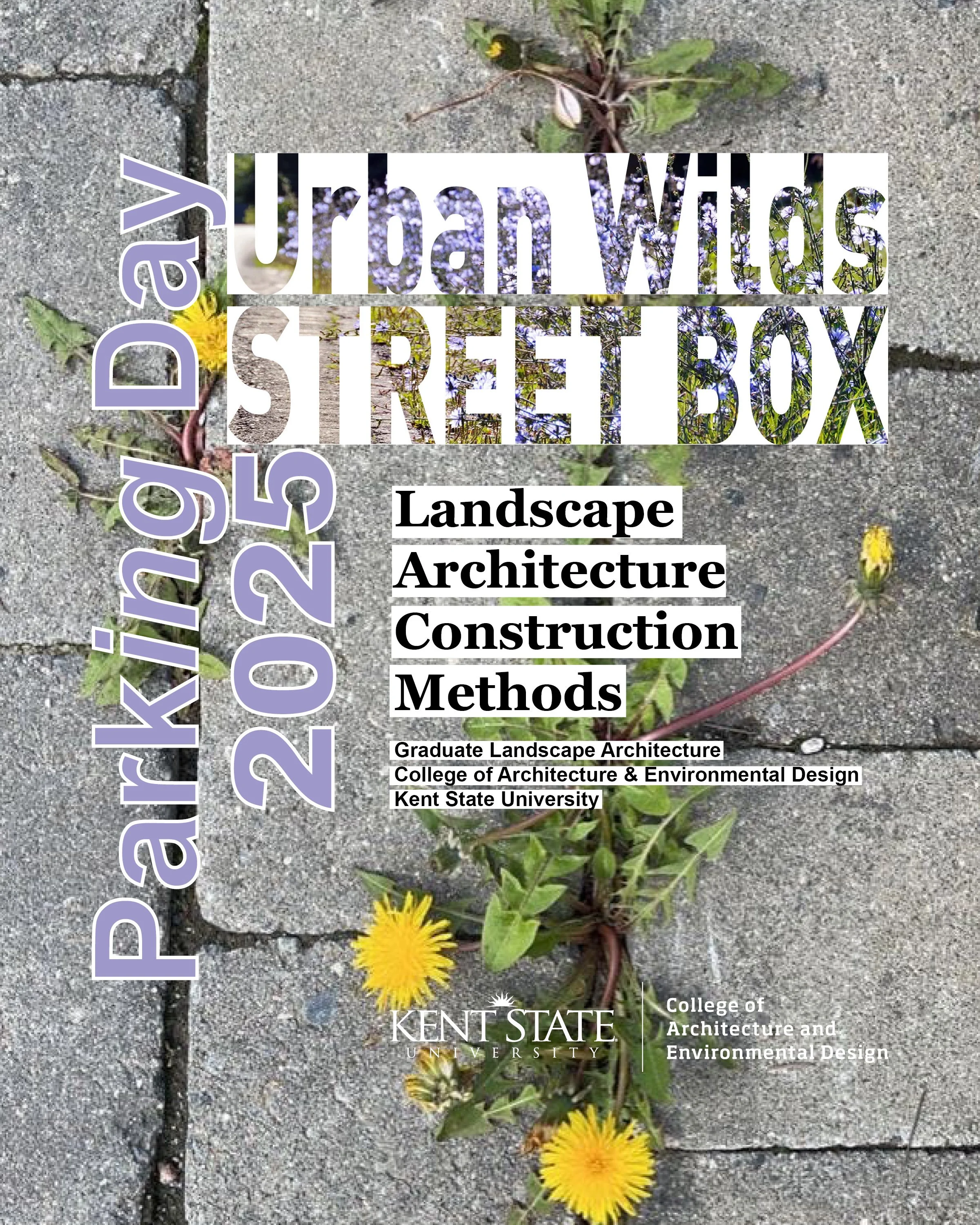
You’re invited!
Play a round of mini-golf and vote on your favorite project!
Friday September, 19 (9am - 5pm)
750 Prospect Ave E
Cleveland, OH 44115
(In front of City Tap)
Minigolf Fareway
For Park(ing) Day 2025, the MLA students are inviting you to engage with our urban sidewalks, parking spaces, right of way, curbs and cracks with our annual minigolf parklet.
Designs explore how the smallest components of our streetscapes can be reimagined into a participatory put-put course. The students worked in collaboration on a modular 'kit' course that will have a second life following parking day where each physical street box prototypes for exploring urban ecology.
Why?
Even the city’s smallest patch (a window box) can affect ecology, habitat and health of the community.
Students were asked to speculate on spontaneous vegetation which contributes to the ecological health of the city. The output course explores how the smallest components of our streetscapes can be reimagined and the future exhibit will demonstrate how these adaptive ecological patches offer our streets more than exotic plants and seasonal flower beds
Background on KSU’s participation in Park(ing) Day:
Park(ing) Day is a staple of the Graduate level Landscape Architecture program at Kent State University’s College of Architecture & Envormental Design. It challenges the idea of traditional street parking spaces and spreads awareness of creating safer, more accessible green streets.
Through the Construction Methods course, students spend time discovering practical construction skills that allow them to design and construct their parking day project. For the past couple of years, the Construction Methods class has used mini golf (putt-putt) as a way to engage people on the streets and spread awareness of the message of Park(ing) Day.
Thank you to this year’s partners!

Just Released: Great Lakes Climate Mobilities

From The Isle of the Itinerant by Jonathan Hanna and Jeffrey Kruth in Great Lakes Climate Mobilities.
Urban Infill Volume 9 - Great Lakes Climate Mobilities was published on 25 April 2025. It is the #1 new release in Sustainability & Green Design on Amazon.
The Cleveland Urban Design Collaborative launched the journal Urban Infill in 2008 as a platform for exploring critical gaps in urban design research and practice. Each volume has illuminated a distinct facet of city life—from the challenges of population loss to the opportunities found in temporary interventions, from the flow of urban waters to the unexpected delights of cold climate cities. Through stories, diagrams, historic preservation strategies, and future visions, the journal has traced the evolving relationships between people and place.
In Volume 9, Great Lakes Climate Mobilities, we turn our attention to a pressing question in the region: how might climate change reshape the human and physical geographies of Great Lakes cities? As wildfires rage in the west, sea levels rise along the coasts, and water grows scarce across vast stretches of the country, the Great Lakes region is in an advantageous (and possibly precarious) position. An abundance of freshwater and relatively stable climate might draw people to the region—yet the timing and scale of such movements are impossible to predict with any certainty.
We have assembled diverse perspectives—designers, planners, community activists, and artists—to explore this complex terrain. Rather than promoting a simple narrative of Great Lakes cities as “climate havens,” contributors lean into the uncertainties ahead. We recognize that climate change is not about winners and losers, but rather a web of interconnected issues that demand a nuanced understanding.
The first section of the journal, Narratives, examines prevailing views of Great Lakes cities as potential receiving zones for climate migrants. This section includes an interview with Jesse Keenan, Associate Professor of Real Estate at the Tulane School of Architecture and a leading voice in national conversations about climate migration, plus a roundtable conversation with Kelley St. John, Missy Stults and Mindy Granley—sustainability directors for the potential “climate haven” cities of Buffalo, Ann Arbor, and Duluth, respectively. This section also includes an exploration of climate futures for New York State grounded in the practice of geodesign and a discussion of the ways that federal agencies and insurance companies impact people’s choices about whether to remain in high-risk regions of the country.


The second section, Counter-Narratives, begins to question prevailing beliefs and assumptions about Great Lakes climate migration and envisions some possible future scenarios through design visualizations, critical analysis, and a play about Buffalo, New York in 2075 entitled, “An Unlikely Refuge.”


The Counter-Narratives section also includes a radical re-imagining of Cleveland by Maira Furtado Faria and Elizabeth Ellis through a series of speculative images, generated by collaging historic photos and present day images in Adobe Firefly, that weave together scenarios for population growth, extreme weather, new work-life patterns, and evolving Great Lakes landscapes. The resulting portfolio makes a poignant statement—that the future city we might wish for resembles the city we once had.

From Collaged Futures: Envisioning Cleveland through AI and History by Maira Furtado Faria and Elizabeth Ellis in Great Lakes Climate Mobilities.
An illustrated poem considers the so-called winners and losers of climate change and serves as an interlude between the Narratives and Counter-Narratives section.
A final Coda considers how climate migration might impact the rights of Lake Erie to exist, flourish, and evolve in the face of a changing climate and a possible influx of new people in the region.

Andrea Bowers: Exist, Flourish, Evolve—a monumental neon sculpture installed at Cleveland’s Great Lakes Science Center, facing Lake Erie.
Copies of Urban Infill Volume 9 - Great Lakes Climate Mobilities are available for $20 at the CUDC, 1309 Euclid Avenue, Cleveland (cash or check only) or on Amazon.
Planetary Ports: A Theory of Infrastructural Urbanization

Friday, April 18, 2025 | 12:00 – 1:00 PM
Cleveland Urban Design Collaborative - 1309 Euclid Avenue, Cleveland, Ohio
In-person and on ZOOM
Speaker: Jeffrey S. Nesbit, Assistant Professor of Architecture & Urbanism, Temple University
Jeffrey S. Nesbit is an architect, urbanist, and founding director of the research group Grounding Design. His work focuses on processes of urbanization, infrastructure, and the evolution of “technical lands.”

Nesbit has over 15 years of experience leading public architecture and urban projects, as well as managing research projects for city governments and NGOs. He has published extensively on “infrastructural urbanization” and hosted interdisciplinary podcast series. He is currently Assistant Professor at Temple University and has taught at Harvard University, University of Pennsylvania, and other leading institutions.
Urban Infill: Great Lakes Climate Mobilities

Cover illustration by Jonathan Hanna and Jeffrey Kruth
Friday, April 25, 2025 | 12:00 – 1:00 PM
Cleveland Urban Design Collaborative - 1309 Euclid Avenue, Cleveland, Ohio
Join us for a panel discussion to celebrate the release of Urban Infill 9: Great Lakes Climate Mobilities, Volume 9 of the CUDC’s journal, Urban Infill.
This hybrid event will take place in-person at the CUDC and over Zoom.
Volume 9, Great Lakes Climate Mobilities focuses on one of the most pressing questions facing Northeast Ohio: How might climate change reshape the human and physical geographies of cities in the Great Lakes region? As wildfires rage in the west, sea levels rise along the coasts, and water grows scarce across vast stretches of the country, the cities of the Great Lakes are in an advantageous and possibly precarious position. An abundance of freshwater and relatively stable climate could draw people to the region - yet the scale and timing of such movements are impossible to predict with any certainty.
In partnership with the University at Buffalo School of Architecture and Planning, this event will bring together diverse voices - designers, planners, writers, and artists - to discuss these complex issues in a hybrid format, in person and over Zoom. This event is free and open to the public.
Copies of Urban Infill Volume 9: Climate Mobilities will be available for $20 at the event. Please note, the CUDC can only accept cash or checks. The journal will also be available for order through Amazon beginning on April 25, 2025.
Designing for Density: A Conversation on Accessory Dwelling Units

Onyx Creative’s winning entry in the Cleveland Heights ADU Competition
Friday, February 7, 2025 | 12:00 – 1:00 PM
Cleveland Urban Design Collaborative - 1309 Euclid Avenue, Cleveland, Ohio
Zoom link: https://us06web.zoom.us/j/88034695285
Join us for an engaging panel discussion on accessory dwelling units (ADUs) and their potential to expand housing options in urban and suburban neighborhoods. This session will explore how ADUs can create opportunities for aging in place, foster diverse housing choices, and integrate sensitively into existing historic contexts.
The conversation will highlight lessons from the Cleveland Heights ADU design competition, sponsored by AARP. Panelists will share insights on design strategies, zoning and regulatory challenges, and best practices for implementing ADUs in communities.
This session offers one hour of professional development credit for planners and is relevant for anyone interested in urban design, land use, and housing policy.
Panelists:
Tommy Chesnes is a Senior Design Architect with Onyx Creative, where he has grown his career since graduating from the CUDC in 2013 with a Master of Architecture and Urban Design. Tommy leads design teams for various project types, including commercial, retail, hospitality, and industrial projects. As a resident of University Heights, he was excited to participate in the Cleveland Heights Accessory Dwelling Unit Competition, where the Onyx Creative team was one of the three winning entries. Tommy hopes to bring these innovative ideas to University Heights, where he serves on the Architectural Review Board.
Patrick W. Hewitt, AICP is a Planning Manager in charge of Strategy & Development with the Cuyahoga County Planning Commission. He has more than a decade of experience in community planning in Cleveland and across the Midwest, and he has served as the lead planner on more than a dozen community planning projects in Cuyahoga County. These planning processes have resulted in updated zoning regulations, community branding campaigns, park and infrastructure improvements, and business district revitalization efforts. He is presently leading the County Planning Commission’s Transit-Oriented Development initiative, which aims to attract more development to frequent transit lines in Cuyahoga County. With a passion for building community, Patrick brings experience on place-based design and community revitalization to the work of County Planning. He is a graduate of Denison University and earned a master’s degree from the Ohio State University in City & Regional Planning.
Rachel Novak, AICP, is a Senior Planner at the Cuyahoga County Planning Commission. With experience in both the private and public sectors, Rachel not only brings an enthusiasm for public outreach, but also a diverse planning background that provides insight on zoning and land use codes, comprehensive planning, and graphic design. She is a Senior Planner and has been with the Cuyahoga County Planning Commission for eight years. She received her Bachelor's Degree in City and Regional Planning from The Ohio State University and is currently pursuing a Master’s Degree in Sustainable Transportation through the University of Washington.
Eric Zamft, AICP, is Director of Planning, Neighborhoods & Development for the City of Cleveland Heights. He is an American Institute of Certified Planners (AICP)-certified planner with over 20 years of experience in housing, planning, transportation, land use, zoning, community development, and sustainability in both the public and private sectors. Eric worked in Philadelphia and the New York metropolitan area prior to he and his family’s move to Cleveland Heights in January of 2021.

Mini Practice Simulation Lab

Breakfast and Lunch are provided as part of the program! We hope to see you there!
1 LU CEU

2024 Park(ing) Day


Park(ing) Day is an international day to recognize and celebrate re utilizing paved on-street parking spaces for higher and better uses.
For nearly 10 years, Kent State Univeristy’s Master of Landscape Architecture students have participated in Park(ing) Day annually in downtown Cleveland. More recently participation has stemmed from a Construction Methods class that offers practical skills to design and build out a space for parking day. Students have the opportunity to interact with local design professionals to support their interests and network with local designers.
The CUDC, as part of it’s 25-year anniversary in downtown Cleveland, participated in Park(ing) Day 2024 by organizing, marketing, and educating the public. Marketing materials included social media posts, the creation of a Park(ing) Day Manual for others to participate, and coordinating the days events with student and professional participants. By advertising this year’s Park(ing) Day, CUDC is hopefull that this event will become a base for more public and private participation next year!
In addition to setting up the day’s events, CUDC staff participated in the day’s event by utilizing Making Our Own Space (MOOS) benches and a shade structure to occupy the parking space.
Graduate Landscape Architecture students participated through the Landscape Construction Methods class and set up individual putt-putt courses to occupy parking spaces.
In total, the event utlized 7 on-street parking spaces and the lawn in front of Cleveland State University’s Levin College. Particpants included CUDC staff, graduate Landscape Architecture students and professional firm participation from LAND Studio, RDL Architects, OHM Advisors, STATICCRAFT and CSU APA’s student chapter. Thank you to everyone who particpated, and we look forward to Park(ing) Day 2025!
On Campus

On Campus, a lecture by Andrew Gutterman, Sasaki Associates
Friday, October 18 from 12-1pm | in-person / hybrid | Register here
Free and open to the public, light lunch will be served.
Andrew Gutterman brings over two decades of professional experience as a landscape architect and his understanding of natural systems to inform all aspects of the planning and design process. His background in ecology has helped foster a deep appreciation for the beauty and complexity of the natural world and a strong belief that these qualities can be brought to the built environment in meaningful ways. Andrew’s thoughtful approach is characterized by attentiveness to client needs, site conditions, and historical context. His experience spans the full spectrum of project types, with a particular emphasis on creating high quality landscapes for academic and institutional clients. Andrew holds a Master in Landscape Architecture from Harvard Graduate School of Design and a Bachelor of Science in Ecology and Evolutionary Biology from the University of Connecticut.

Landscape Architect Andrew Gutterman
Party Wall Common
A new exhibition by architect and urban designer Petra Kempf at Kent State University’s Cleveland Urban Design Collaborative
1309 Euclid Avenue, Suite 200 | Cleveland, Ohio 44115 | 216.357.3426 | cudc.kent.edu
Opening reception and gallery talk: October 24, 2024 from 5:30-7pm
Gallery hours:
Monday – Friday from 9am - 4pm from October 25 through November 25, 2024 and Saturday, November 2, 2024 from 10am – 2pm.
Free and open to the public.

Imagine you live in a house
where sharing space, kitchen appliances, or knowledge is not based on transactions, but care.
Imagine a door opens to a mini house providing a caregiver from abroad,
a single parent, or a student from another city access to a different life.
Imagine a place where children and the elderly are an integral part of a community.
Imagine a diverse group of people sitting at a table and everyone is part of the conversation.
Imagine a house where the world gathers This is the idea behind Party Wall Common.
The subdivision of land into private property plays a crucial role in shaping a society’s coexistence. This condition is particularly apparent in an urban environment, where the grid has become a facilitator of the right to own land, enabling humans to abstract their relationship to one another and the environment they inhabit. The resulting degradation of land and the rising intensities of weather patterns have compelled a recognition of the link between the exploitation of resources and the concept of ownership. Hence, the monetization of resources, as well as the wasteful consumption of synthetic and organic matter, suggest the actual limits of this type of thinking. In light of these ecological and societal circumstances, there is a pressing need to rethink existing systems of ownership.
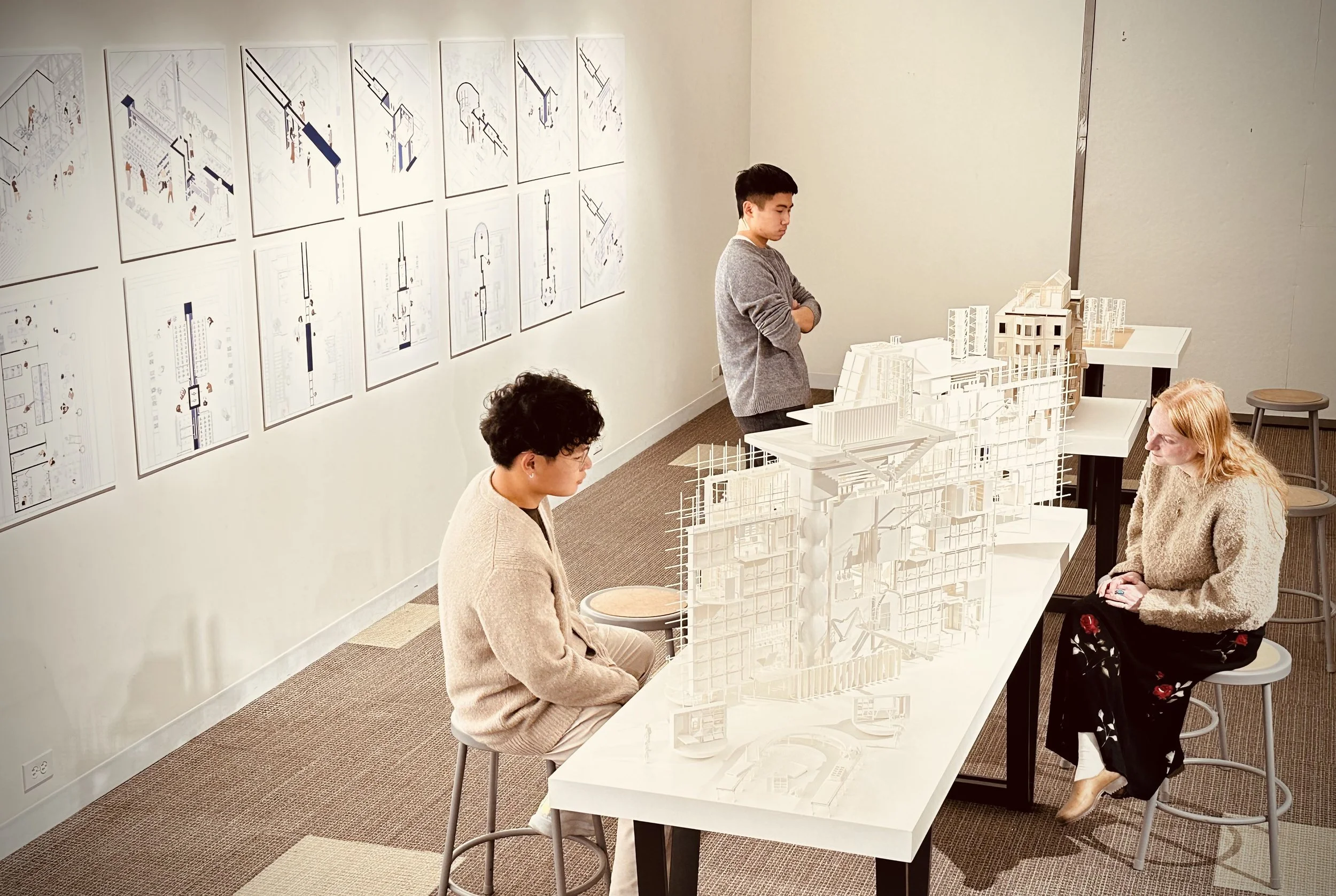
This exhibition examines the concept of ownership, as well as the challenges pertaining to our disconnection from one another and our environment, by exploring the legal and spatial conversion of party walls typical of row house typology into a common ground. In such a common ground, neither the public nor the private “governs”; rather, a multitude of interactions generated by a collective body embracing a field of changing configurations, by which the duality of “I” versus “THEY” is permeated by a third entity: the “WE”. The notion of “we” is the legal and spatial materialization of a common ground in which a collective embraces a form of ownership that is devoid of exploitation and is committed for the long term, that centers around social equity and care for the environment, while sharing both material and immaterial resources. Inhabiting the Party Wall Common enables this transformation to happen.

Architect and urban designer, Petra Kempf
Petra Kempf, Ph.D., is an assistant professor at the Sam Fox School of Design and Visual Arts at Washington University in St. Louis. She is an architect, urban designer, and educator. Her creative practice and research speculate on how the assemblage of collective living has been influenced by urbanization. Within these parameters, her investigations are centered on regenerative ways of living, based on reflective, responsive, and reciprocal relationships, to confront the pressing challenges to the environment as well as the changing life parameters of urban citizens living in an urban environment today. As part of this research, Kempf introduced the methodology of game making into the pedagogy at the Sam Fox School as an emerging syntax in the exploration and approach to urban life.
Kempf has worked at institutions within the public and private sector, including the New York City Department of City Planning, the Project for Public Spaces, and Richard Meier & Partners. She has taught at schools throughout the U.S. and Europe, including the Rhode Island School of Design, Columbia University, Cornell University, Parsons School of Design, Pratt Institute, and the University of Dortmund, Germany. She earned a DAAD (German Academic Exchange Service) Fellowship, the Architectural League of New York’s Young Architect Award, and grants from the Graham Foundation for Advanced Studies in the Fine Arts and the Mellon Foundation. She is the founder of Confront(ing) Urbanization, an interdisciplinary research initiative with focus on how the assemblage of collective living has been influenced by urbanization.
Her work has been exhibited at venues such as Architecture Venice Biennale and Chicago Biennale, the Carnegie Museum of Art in Pittsburgh, Pink Comma Gallery in Boston, and Roca Gallery in London, among other galleries and academic institutions in the U.S. and Europe, such as Cornell University and Rhode Island School of Design. She has published a series of articles and is the author of “You are the City” and “(K)ein Ort Nirgends, Der Transitraum im urbanen Netzwerk.”
Climate Action as if the Earth Mattered
Climate Action as if the Earth Mattered: Restoring living systems as the essential foundation to solving the polycrises we face
Please join us Friday, September 27, 2024 at noon for a lecture at the CUDC featuring Brett KenCairn, Founding Director, Center for Regenerative Solutions.
This event will be in-person and livestreamed on Zoom. Register here
Free and open to the public. A light lunch will be provided.
Brett is the Founding Director of Center for Regenerative Solutions and Senior Policy Advisor for Climate and Resilience in the City of Boulder’s Climate Initiatives Team. He coordinates the city’s nature-based solutions work. Brett has worked across the western US in community-based initiatives in rural, Native American, and other marginalized communities. He is the co-founder of multiple organizations including the Rogue River Institute for Ecology and Economy, Veterans Green Jobs, and Community Energy Systems.
Since the early 1970s, we have known that there were two fundamental causes of climate destabilization—fossil fuel combustion and land degradation. Over the past several decades, the role of land degradation has been largely forgotten in the focus on carbon accounting and energy systems change. Current climate action strategies will inevitably fail unless we reestablish a global-scale focus on restoring the more than 70% of the Earth’s living systems that have been deeply degraded—both in natural, working and urban lands.

The good news is that we have examples of large-scale initiatives of this sort that can achieve remarkable regenerative results in the scale of just a few decades. In this talk, we will walk through the limitations to current climate action approaches and outline a broader strategy that can serve as the foundation for both climate stabilization (and a number of other aspects of the “polycrisis”) and a community redevelopment strategy that can stabilize both urban and rural communities both here and abroad.

Power + Place

Remember Then Remember When
Power + Place
Bryan C Lee Jr, Design Principal, Architect, Colloqate
Please join us Monday, September 23 at 5:30pm for a lecture at the CUDC featuring Bryan C. Lee.
In-person event at the CUDC, 1309 Euclid Avenue, Suite 200, Cleveland, Ohio
Free and open to the public. | Refreshments will be provided.
Bryan C. Lee Jr. is an award-winning architect, nonprofit founder, and leading national voice on anti-racist and socially just design. As Founder and Design Principal of Colloqate Design, Bryan spearheads the organization’s mission to intentionally design spaces advancing racial, social and cultural equity. This encompasses community-centered architecture and planning projects, youth education/mentorship initiatives, and advocacy campaigns confronting systemic exclusion in the built environment. Deeply committed to expanding opportunity in his home city of New Orleans, Bryan previously served as the Inaugural Director of Place + Civic Design for the Arts Council New Orleans from 2015 to 2017. In this capacity, he provided vision and program management for arts-rooted community development efforts citywide.

Nationally recognized as an influential thought leader, Bryan’s recognitions include being named on Fast Company’s 2018 Most Creative People in Business list as well as receiving prestigious fellowship designations such as Emerging Voices from the Architectural League of New York and United States Artists. As a Design Critic at Harvard University’s Graduate School of Design since 2020, Bryan has brought his justice-oriented pedagogy to new generations of architects and planners. Bryan holds leadership positions with the National Organization of Minority Architects (NOMA) and the Design As Protest Collective organizing against professional exclusion. Through his career and volunteerism, Bryan embodies his belief in design as instrumental for empowerment, healing historical harms, and expanding liberation across communities.

Multnomah County Midland Library
CUDC Fall 2024 Program Series

Kent State’s Cleveland Urban Design Collaborative (CUDC) announces our Fall 2024 schedule of lectures and programs, celebrating the CUDC's 25th Anniversary in Cleveland.
This fall, we present an exciting series of programs that interrogate the critical intersections of environmental sustainability, social equity, and innovative design. As we navigate an era marked by profound ecological and social challenges, the role of design in shaping resilient and equitable urban environments has never been more pivotal.
This series convenes thought leaders from diverse fields—landscape architecture, architecture, urban design, social justice advocacy, climate science, and ecological restoration—to explore how interdisciplinary approaches can drive meaningful change.
The lectures and exhibition will inspire you to look forward to a more sustainable future by offering a nuanced exploration of how the built environment can be reimagined to address the pressing crises of our time and foster a more inclusive and sustainable future.
Through these dialogues, we will uncover design's transformative potential as a reflective and proactive force in shaping the world we aspire to create.
All events will be held at the Cleveland Urban Design Collaborative :
1309 Euclid Avenue, Suite 200 | Cleveland, Ohio
All events are free and open to the public. Snacks and refreshments will be served.
More information: 216.357.3434 | cudc@kent.edu
MONDAY SEP 9 | 12-1:30PM | in-person/hybrid | Register here
Preserving our Future – Environmentally, Equitably, and Economically in partnership with AIA Cleveland
Sara Zewde, ASLA, Studio Zewde and Phil LiBassi FAIA FACHA, Senior Principal DLR Group & Conservancy for Cuyahoga Valley National Park Board Member
The program focuses on the account of preserving a tract of land within the boundaries of the Cuyahoga Valley National Park from development. This is a great example of how public-private efforts such as this can contribute to shaping our world. The program will also focus on the process, players, partnerships and plans that are making an impact in our own backyard.
The Conservancy for the Cuyahoga Valley National Park has worked diligently to save this property in the heart of the park to protect habitat as well as to create a space for all to enjoy the land and Cuyahoga River. In the fall of 2023, the Conservancy hired Studio Zewde to assist with community engagement initiatives, site analysis and a framework for development.
Studio Zewde is led by Founding Principal, Sara Zewde. She brings years of experience leading complex design processes across the Americas, with a design approach that works explicitly to illuminate the distinct cultural and ecological qualities of a place. Sara is Assistant Professor of Practice at Harvard University’s Graduate School of Design and is the recipient of several awards, including the Hebbert Award for Contribution to the Department of Urban Studies and Planning at MIT and the Silberburg Memorial Award for Urban Design. Studio Zewde is devoted to creating enduring places where people belong. https://www.studio-zewde.com.
Phil LiBassi is a practicing architect with over 45 years of experience. A Fellow in the American Institute of Architects (FAIA) and American College of Healthcare Architects (FACHA), he has been instrumental in leading a successful architectural practice and was actively involved in several award-winning commissions nationally in healthcare, cultural and performing arts, higher education and government.
MONDAY SEP 23 | 5:30-7PM | in-person
Power + Place
Bryan C Lee Jr, Design Principal, Architect, Colloqate
Bryan C. Lee Jr. is an award-winning architect, nonprofit founder, and leading national voice on anti-racist and socially just design. As Founder and Design Principal of Colloqate Design, Bryan spearheads the organization’s mission to intentionally design spaces advancing racial, social and cultural equity. This encompasses community-centered architecture and planning projects, youth education/mentorship initiatives, and advocacy campaigns confronting systemic exclusion in the built environment. Deeply committed to expanding opportunity in his home city of New Orleans, Bryan previously served as the Inaugural Director of Place + Civic Design for the Arts Council New Orleans from 2015 to 2017. In this capacity, he provided vision and program management for arts-rooted community development efforts citywide.
Nationally recognized as an influential thought leader, Bryan’s recognitions include being named on Fast Company’s 2018 Most Creative People in Business list as well as receiving prestigious fellowship designations such as Emerging Voices from the Architectural League of New York and United States Artists. As a Design Critic at Harvard University’s Graduate School of Design since 2020, Bryan has brought his justice-oriented pedagogy to new generations of architects and planners. Bryan holds leadership positions with the National Organization of Minority Architects (NOMA) and the Design As Protest Collective organizing against professional exclusion. Through his career and volunteerism, Bryan embodies his belief in design as instrumental for empowerment, healing historical harms, and expanding liberation across communities.
FRIDAY SEP 27 | 12-1PM | in-person / hybrid | Register here
Climate Action as if the Earth Mattered: Restoring Living Systems as the Essential Foundation to Solving the Polycrises We Face
Brett KenCairn, Center for Regenerative Solutions
Since the early 1970s, we have known that there were two fundamental causes of climate destabilization—fossil fuel combustion and land degradation. Over the past several decades, the role of land degradation has been largely forgotten in the focus on carbon accounting and energy systems change. Current climate action strategies will inevitably fail unless we reestablish a global-scale focus on restoring the more than 70% of the Earth’s living systems that have been deeply degraded—both in natural, working and urban lands. The good news is that we have examples of large-scale initiatives of this sort that can achieve remarkable regenerative results in the scale of just a few decades. In this talk, we will walk through the limitations to current climate action approaches and outline a broader strategy that can serve as the foundation for both climate stabilization (and a number of other aspects of the “polycrisis”) and a community redevelopment strategy that can stabilize both urban and rural communities both hear and abroad.
FRIDAY OCT 18 | 12-1PM | in-person / hybrid | Register here
On Campus
Andrew Gutterman, Sasaki Associates
Andrew brings over two decades of professional experience as a landscape architect and his understanding of natural systems to inform all aspects of the planning and design process. His background in ecology has helped foster a deep appreciation for the beauty and complexity of the natural world and a strong belief that these qualities can be brought to the built environment in meaningful ways. Andrew’s thoughtful approach is characterized by attentiveness to client needs, site conditions, and historical context. His experience spans the full spectrum of project types, with a particular emphasis on creating high quality landscapes for academic and institutional clients. Andrew holds a Master in Landscape Architecture from Harvard Graduate School of Design and a Bachelor of Science in Ecology and Evolutionary Biology from the University of Connecticut.
THURSDAY OCT 24 | 5:30-7 PM | in-person
Party Wall Common (Exhibition opening & Gallery Talk)
Petra Kempf, Sam Fox School of Design & Visual Arts, Washington University
By exploring regenerative ways of living that are based on reflective, responsive, and reciprocal relationships between human to human-, human to non-human-, and non-human to non-human agencies, what kind of spatial configuration embody a life that allows for inclusive forms of living to enable alternative forms of ownership towards a common ground without ignoring current modes of free market exchange?
Party wall common. Party wall as a conversion from space into place. 30 vignettes exploring what can happen at the party wall.
The exhibition will be open to the public October 25 through November 25, 2024 Monday – Friday from 9am - 4pm and on Saturday, November 2, 2024 from 10am – 2pm.
CUDC Strategic Plan - Celebrating 25 Years in Cleveland

Kent State’s Cleveland Urban Design Collaborative recently completed a new strategic plan, with generous support from the Ohio Arts Council. Our strategic planning process was facilitated by Ann Zoller of Strategy Design Partners and included input from public officials, non-profit partners, community clients, and community design centers elsewhere in the country. The resulting plan enabled the CUDC to reflect back on our 25 years of work in Cleveland and look forward to new opportunities with renewed energy and vision.
Rapid changes are taking place at Kent State and among the CUDC’s partners and funders and this is having a major impact on our work. The new strategic plan aims to help the CUDC team navigate uncertainty, discover new opportunities in change, and take some calculated risks.
Recommendations in the CUDC’s new strategic plan align with four important goals:
To create a more sustainable business model built on strategic partnerships that reflect aligned priorities, can produce more stable revenue and can enact meaningful change in the market.
To better align the strengths, resources, capacities and ongoing priorities of the CUDC and the CAED for a more integrated and effective relationship.
To evolve the programs of the CUDC to better reflect market needs and priorities in a way that highlights the unique assets and capacity of the organization and complements the business model.
To invest in organizational infrastructure, knowledge transfer and culture as a means of sustaining the organization and planning for leadership succession.
The plan includes a series of actions that align with these goals along with a timeline for implementation.

If you’re interested in learning more about how the CUDC is adapting to changing circumstances, please reach out to us at cudc@kent.edu or plan to attend events and programs in our upcoming 25th anniversary year.


CITY DREAMERS - FILM SCREENING

Women’s History Month Film Screening at the CUDC, 1309 Euclid Avenue
Please join us at noon on March 15, 2024 for a free screening of City Dreamers, a film about our changing urban environment and four women architects, inspiring trailblazers with over 60 years of experience each, who are working, observing and thinking about the transformations that are shaping the city of today and tomorrow. This event is free and open to the public. Pizza and popcorn will be served.
2024 Hines Student Team Receives Honorable Mention

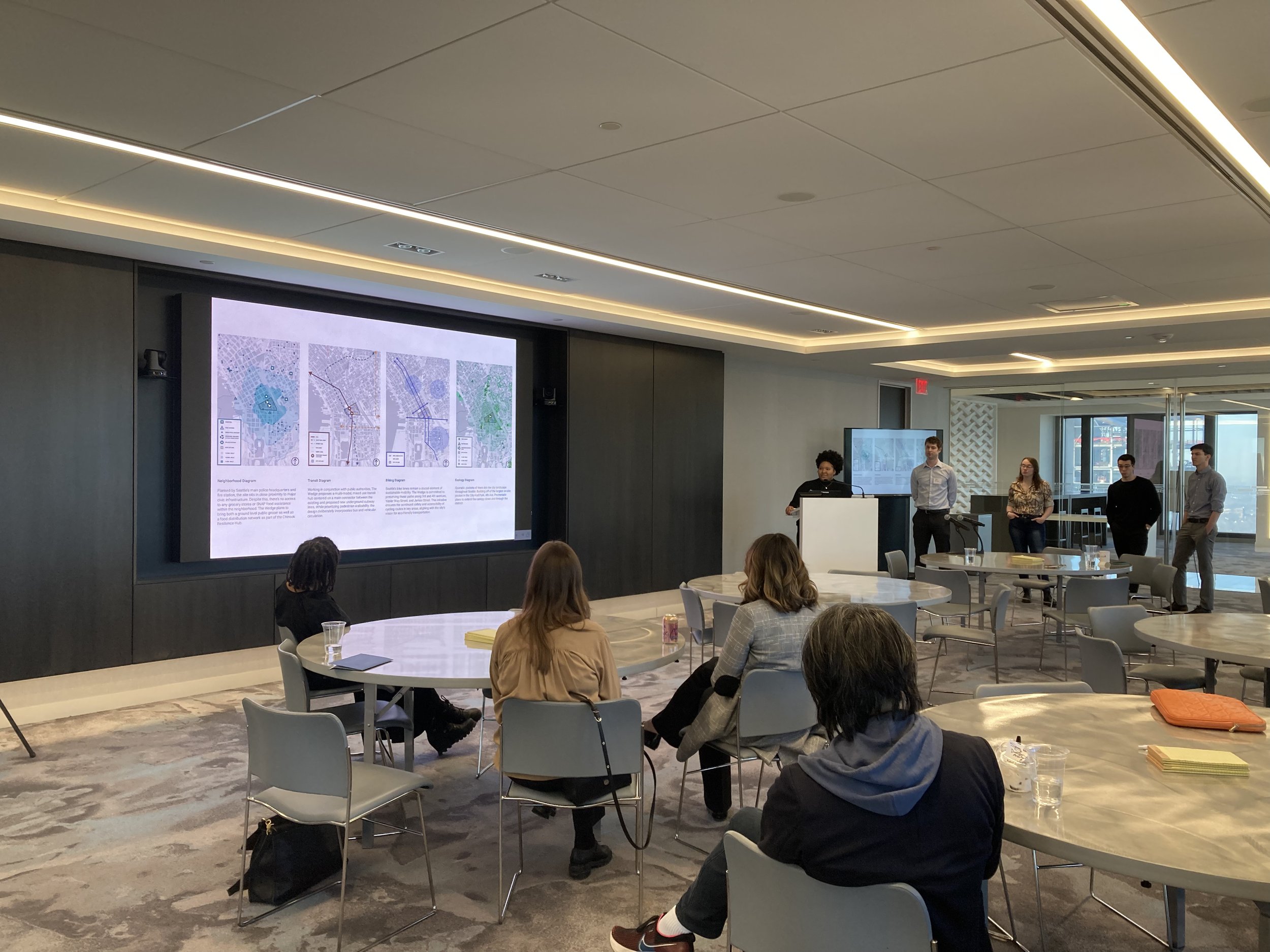
In its 22nd year, the ULI Hines Student Competition offers graduate students a unique opportunity to tackle real-world land use challenges in North American cities. Founded by Gerald D. Hines, the competition fosters innovation and collaboration among students, highlighting the importance of multidisciplinary solutions in urban development. With over 11,000 participants worldwide since 2003, it has become a cornerstone in shaping the future of urban planning and design.
For Architecture and Urban Design students at Kent State University and Planning students at Cleveland State University, this competition is an exciting challenge. It provides students with invaluable hands-on experience, bridging academic learning with practical insights into urban development complexities. Our partnership with the Urban Land Institute further enhances our commitment to excellence in urban design and planning education, offering students access to industry expertise, mentorship, and a vast professional network.

This year's challenge focuses on revitalizing a designated site in downtown Seattle, addressing real-world conditions with innovative and sustainable proposals for a vibrant, mixed-use, mixed-income neighborhood. Congratulations to Drew Thompson, Christopher Rini, Jyae McWilson, Edgardo Mcgorty, and Raz Rasmussen from Cleveland State University and Kent State University, alongside ULI Members Ken Kalynchuk and Alex Long, CSU advisor Roby Simons, and and CUDC advisors Maira Faria, Elizabeth Ellis and Terry Schwarz, for their exceptional contributions to this year's competition.
For more information: ULI CLEVELAND - 2024 Hines Student Team Receives Honorable Mention
Urban Infill Volume 9 | Great Lakes Climate Migration

Call for Submissions: Envisioning Climate Migration in Great Lakes Cities
Infill examines themes in contemporary urban design, architecture, and planning. Past volumes have addressed shrinking cities, temporary urbanism, urban hydrology, urban design narratives, historic preservation, cold climate cities, and other topics.
Urban Infill #9 will explore how climate change could impact population, land use patterns, and urban design approaches in Great Lakes cities. Some cities in the Great Lakes region have been identified as potential “climate havens”–places where people might move to avoid hazards associated with climate change such as hurricanes, sea level rise, extreme heat, and wildfires.
No one knows for sure how many people in the United States may need to move due to the effects of climate change. Since the Great Lakes region has ample access to fresh water and a relatively stable climate, cities around the Great Lakes could experience population growth due to climate migration. But when and to what extent this will happen remains to be seen.
The CUDC, in collaboration with the University at Buffalo School of Architecture and Planning, invite designers, planners, writers, and artists to submit their work for this publication. Our goal is not to advance a predetermined vision of Great Lakes cities as climate havens, but to explore the ambiguities and uncertainties inherent in a changing climate. We recognize there will be no true winners or losers when it comes to climate change, but rather a series of complex interrelationships and competing needs.
We’re interested in Great Lakes-focused work, and also approaches to climate migration from other parts of the world that may have lessons for our region.
We are seeking submissions that address one or more of these themes:
EQUITY Privileged versus forced migration, the risks of climate gentrification, the needs of existing and historically underserved communities, Indigenous land and water rights.
DESIGN NARRATIVES Drawings, diagrams, and stories that explore future scenarios and speculate about the possibilities of climate migration in tangible and detailed ways.
STRATEGIES & INDICATORS How can communities plan for the possibilities of climate migration? How will we know if climate migration is underway and to what extent? What are the tipping points and triggers for taking action and shifting gears as we see how things are playing out?
Submission Guidelines:
Submissions may include images, graphics, diagrams, and/or text. Text should not exceed 1,500 words. Image-oriented pieces are limited to what can be legible on up to six pages of the journal. Page format is 8.5” square.
We will only consider finished work. Please do not submit an abstract, proposal or outline. If your piece is accepted for publication by the Urban Infill editorial board, you will have an opportunity to make revisions as needed.
Please include the author’s name(s), affiliation, mailing address, email address, and short biography on the first page of the submission.
Titles should be concise and descriptive of your work.
Text should be written in an accessible, jargon-free style for an informed general audience.
Please avoid footnotes or endnotes; incorporate references into the text.
For issues of style, we use The Chicago Manual of Style (University of Chicago Press).
Images in any format (.jpg, .tif, .pdf, etc.) are welcome. Please include low-resolution versions of your images with your initial submission.
Please send your work to cudc@kent.edu. Include “Urban Infill” in the subject line of your email.
Important Dates:
Submissions due: 10 April 2024
Notification to selected contributors, with editorial comments: 1 May 2024
Final edits due: 24 May 2024
Expected publication: September 2024
Questions?
Please contact the Urban Infill editorial team at cudc@kent.edu.
CUDC Spring Lecture Series
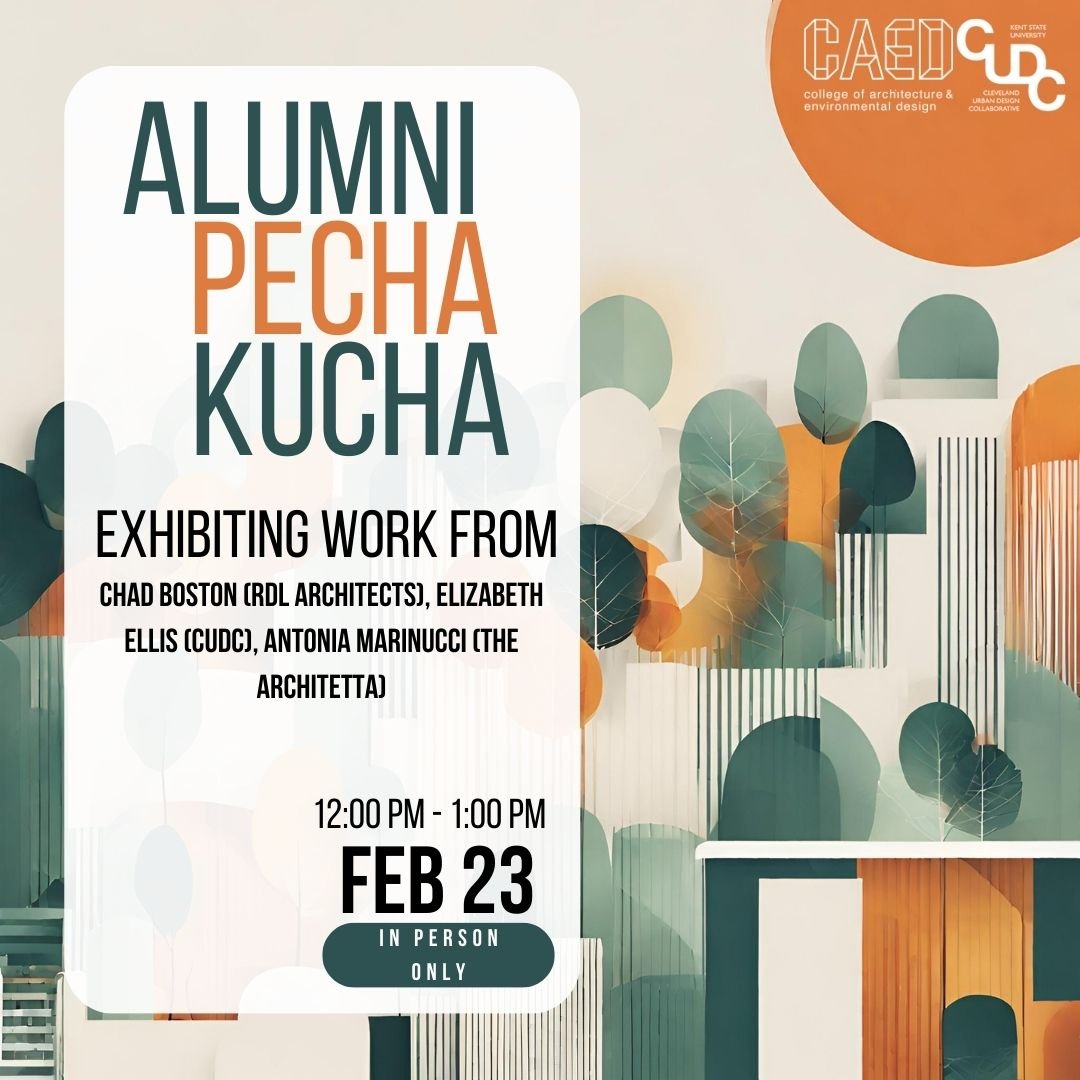
The CUDC’s spring lecture series kicks off with a Pecha Kucha-style event on Friday, February 23, 2024 from noon-1pm.
Please join us for short presentations by alumni of Kent State University’s graduate programs in Architecture, Urban Design, and Landscape Architecture.
In-person only at the CUDC, 1309 Euclid Avenue, Suite 200, Cleveland. A light lunch will be served. Reservations are not necessary.
Speakers include:
Chad Boston, Project Designer, RDL Architects
Jason Burick, Senior Associate | Design Director, Vocon
Elizabeth Ellis, Senior Urban Designer, Cleveland Urban Design Collaborative
Antonia Marinucci, Founder, The Architetta

Andy Bako, Schidlowski Fellow at Kent State’s College of Architecture and Environmental Design, will give an in-progress talk entitled TRAIN YOURSELF. The event will be held at the CUDC on March 8 from noon-1pm.
In-person only at the CUDC, 1309 Euclid Avenue, Suite 200, Cleveland. A light lunch will be served. Reservations are not necessary.

The final event in the CUDC’s Spring 2024 lecture series is Design Justice: Power + Space with Bryan C. Lee Jr., Architect and Design Principal at Colloqate Design. This event will be April 8, from 5-7pm at the CUDC, 1309 Euclid Avenue, Cleveland - in-person and livestreamed over Zoom.
Anticipated but Unpredictable: Planning for Great Lakes Climate Migration
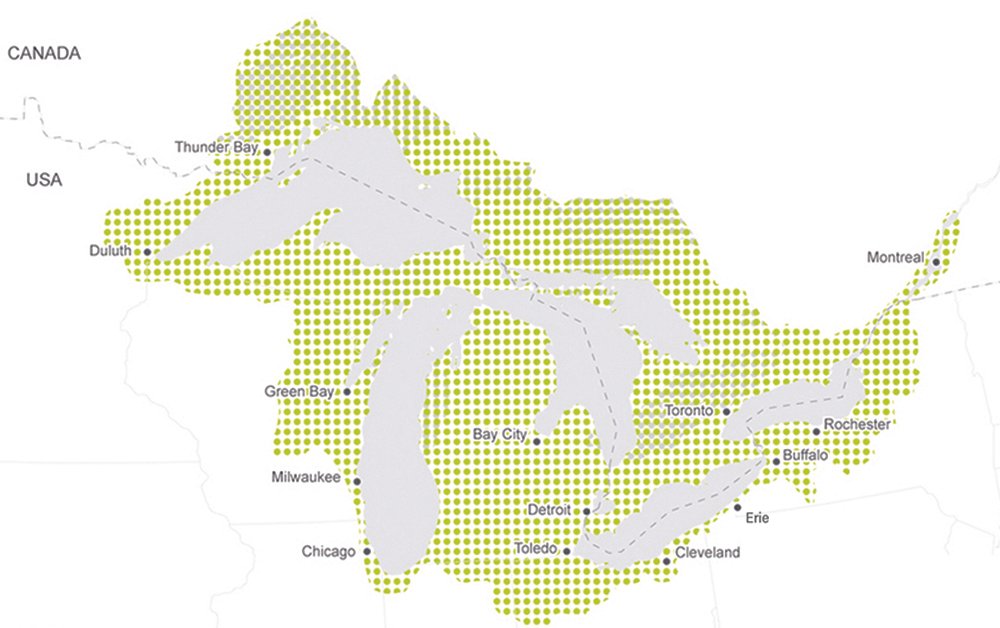
Major cities of the Great Lakes Basin (Source: Third Coast Atlas)
The impacts of climate change could displace many people in some regions of the United States. Cities in heavily impacted areas could lose residents and tax revenue as people relocate to safe havens. Other cities will receive displaced people, perhaps suddenly and without warning, in the wake of a climate disaster. There is a pressing need to prepare for these population shifts in an organized and equitable way.
Great Lakes cities have already experienced periods of population growth and decline. The Great Migration, from 1910-1970, was one of the largest movements of people in U.S. history. Approximately six million Black Southerners moved to cities in the Northern, Western, and Midwestern parts of the US to escape racial violence and pursue economic and educational opportunities.
Many people moved to Detroit, Cleveland, Buffalo, and other cities in the Great Lakes where industrial jobs were plentiful. As deindustrialization took hold in the 1970s and 1980s, these cities lost residents and businesses—a pattern that persists to the present day. However, the Great Lakes region may begin to experience climate-related in-migration as people rediscover the area’s stable climate, abundant fresh water, and available land.
Long-predicted climate concerns are becoming a reality–with heat waves gripping the southern and southwestern parts of the country, flash flooding inundating cities on the East Coast, wildfires raging in Canada, and a rapidly warming ocean setting the stage for destructive hurricanes in the Gulf Coast. As Al Gore recently noted, “Every night on the TV news is like taking a nature hike through the Book of Revelation.”
And yet, the population continues to grow in high risk areas of the country, while many Great Lakes cities are still losing population. How difficult will conditions need to become before national patterns of population growth and decline begin to change? Will the revitalization of Great Lakes cities be inextricably linked to climate disasters in other parts of the country?
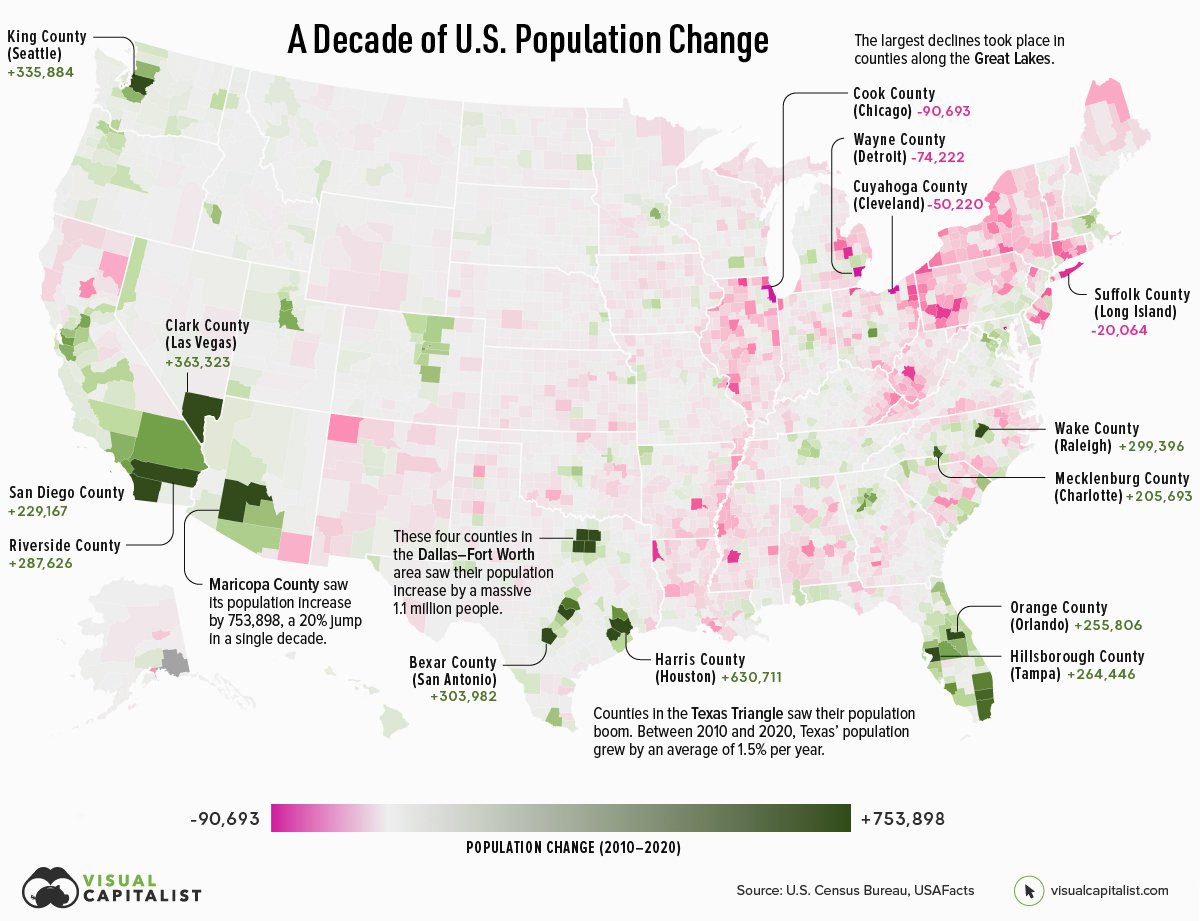
Cities facing severe climate risks continue to grow, while many of the relatively stable and temperate cities of the Great Lakes are losing population. (Source: Visual Capitalist)
If Great Lakes cities begin to attract new residents, what factors will motivate people to move and when might this happen? Will in-migration bring jobs, ideas, and money to help revitalize the Great Lakes region? Will new residents displace people who are already here? Will population growth be concentrated in existing cities, or will it result in an expanded development footprint in suburban and rural areas? How will in-migration affect the ancestral claims of Indigenous people on the land and water of the Great Lakes basin?

Diagram exploring four climate migration scenarios, looking at possible outcomes if Cleveland experiences moderate or severe climate impacts, in a context of future population growth or decline.
In an effort to spark conversations about these and other questions, the CUDC and the University at Buffalo partnered to produce a guide to scenario planning for climate migration in Great Lakes cities. The guide aims to assist Great Lakes cities in making climate-responsive land use decisions, planning for population gains and losses, and developing scenarios about where to focus future development and where to protect land for green space and green infrastructure.
Download the Guide to Scenario Planning for Great Lakes Climate Migration
In March of 2023, the CUDC hosted a half-day climate migration workshop to explore future migration patterns in the US and the climate-related forces that may drive people and businesses to Northeast Ohio. The workshop was sponsored by the Lincoln Institute of Land Policy (LILP) and the Urban Institute in partnership with the Cuyahoga County Office of Sustainability, the University at Buffalo, and the CUDC.
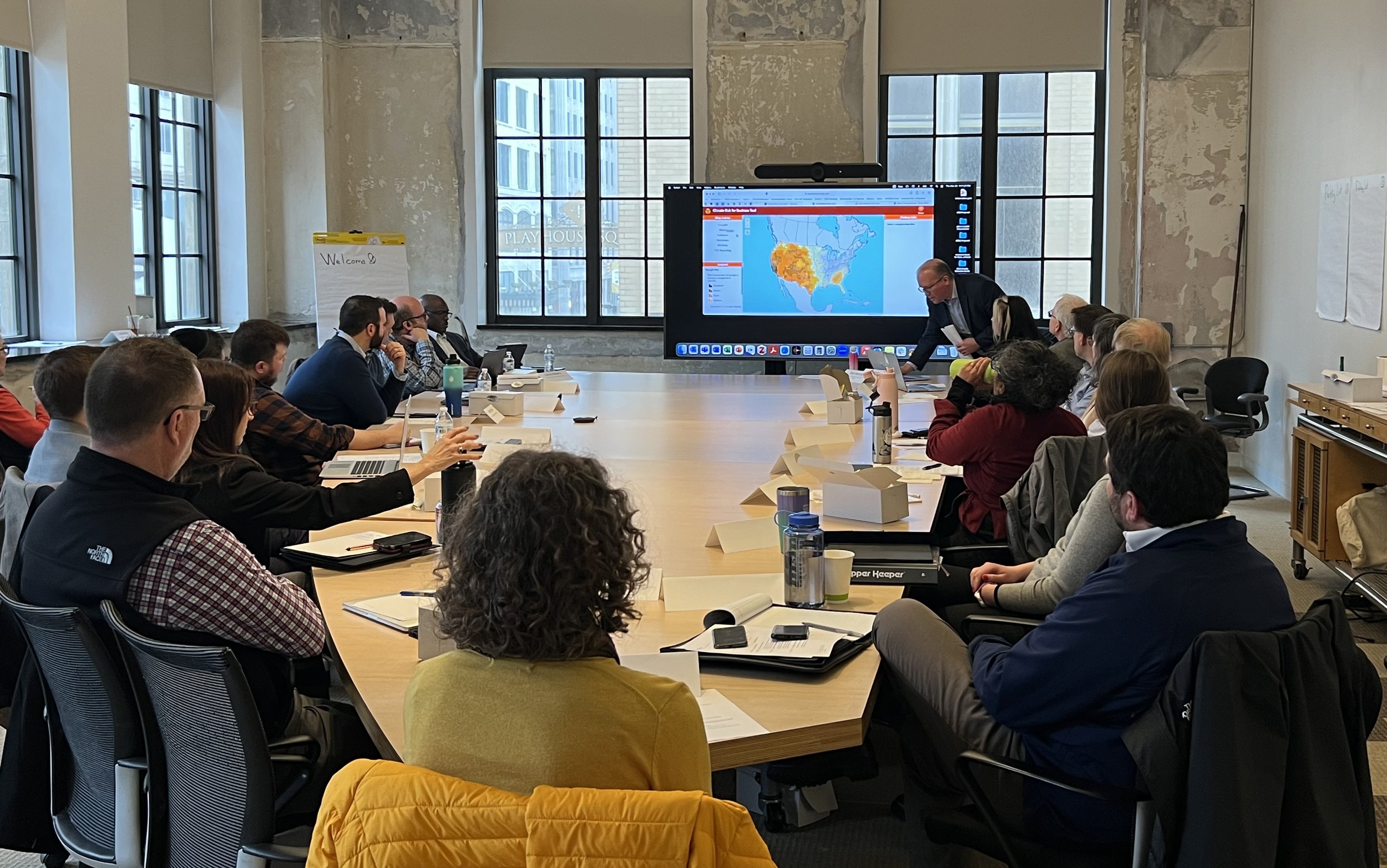
Climate migration workshop at the Cleveland Urban Design Collaborative, 23 March 2023.
Twenty-three people participated in the workshop including local government representatives in land-use planning, water and sewer infrastructure, sustainability, emergency services, and land banking. Nonprofit and philanthropic organizations participating in the event included the Cleveland Water Alliance, the Cuyahoga County Land Reutilization Corporation, the Cleveland Foundation, and the George Gund Foundation. Regional agencies, including the Northeast Ohio Regional Sewer District, the Northeast Ohio Areawide Coordinating Agency, and Dominion Energy also participated.
Following the principles of XSP, the workshop considered a range of possible scenarios rather than focusing on a single preferred vision of the future. XSP helps communities navigate uncertainty and prepare for a variety of outcomes that could happen, without knowing specifically what will happen. The XSP process is useful for discussions about climate change and climate migration since these issues involve many unknown factors.

Group exercise at the climate migration workshop exploring development scenarios for climate-driven population growth or decline in Cuyahoga County. Scenarios explore where future growth would be concentrated on vacant sites within the existing urban footprint, or at the periphery of the region.
Workshop participants discussed current and anticipated climate challenges in Cleveland and Cuyahoga County, as well as opportunities for attracting climate migrants to the Northeast Ohio region. The conversation did not begin from a preconceived position that Cleveland is destined to become “climate haven.” Although the impacts of climate change in Northeast Ohio may be less severe than in other parts of the US, Cleveland and Cuyahoga County are not immune to the effects of climate change. Workshop exercises encouraged participants to consider a range of scenarios and grapple with the uncertainties inherent in climate change and climate migration.
The half-day workshop format was not enough time for participants to delve into all the issues related to climate migration. By incorporating mapping exercises into future workshops, more site-specific scenarios for climate migration in the region might emerge. Expanding the workshop to a full-day event or conducting a series of sessions spread over weeks or months, could yield more comprehensive and detailed outcomes.
The CUDC and project partners prepared a case study documenting the process and outcomes of the workshop. The case study also includes a range of topics that were not addressed in the workshop, but could become part of future research into the promise and perils of climate migration into the Great Lakes region. These topics include: mapping and geospatial analysis for climate migration planning; understanding the timeframe in which climate migration might take place; aligning the forces that push people from one community and pull them toward another; adaptive management approaches; and regional collaboration to prepare for a changing climate.
MOOS Rapid Response Team in Brighton Park

MOOS Rapid Response Team at Old Brooklyn Community Development Corporation
In an effort to expand racial and ethnic diversity in the design fields, Kent State’s Cleveland Urban Design Collaborative created Making Our Own Space (MOOS), a design/build program for middle and high school students. The program introduces youth to opportunities in architecture, urban design, and landscape architecture. Since 2015, MOOS has been helping educate youth on design fundamentals, construction, design, and community engagement. MOOS serves as an incubator for design thinkers and problem-solvers.
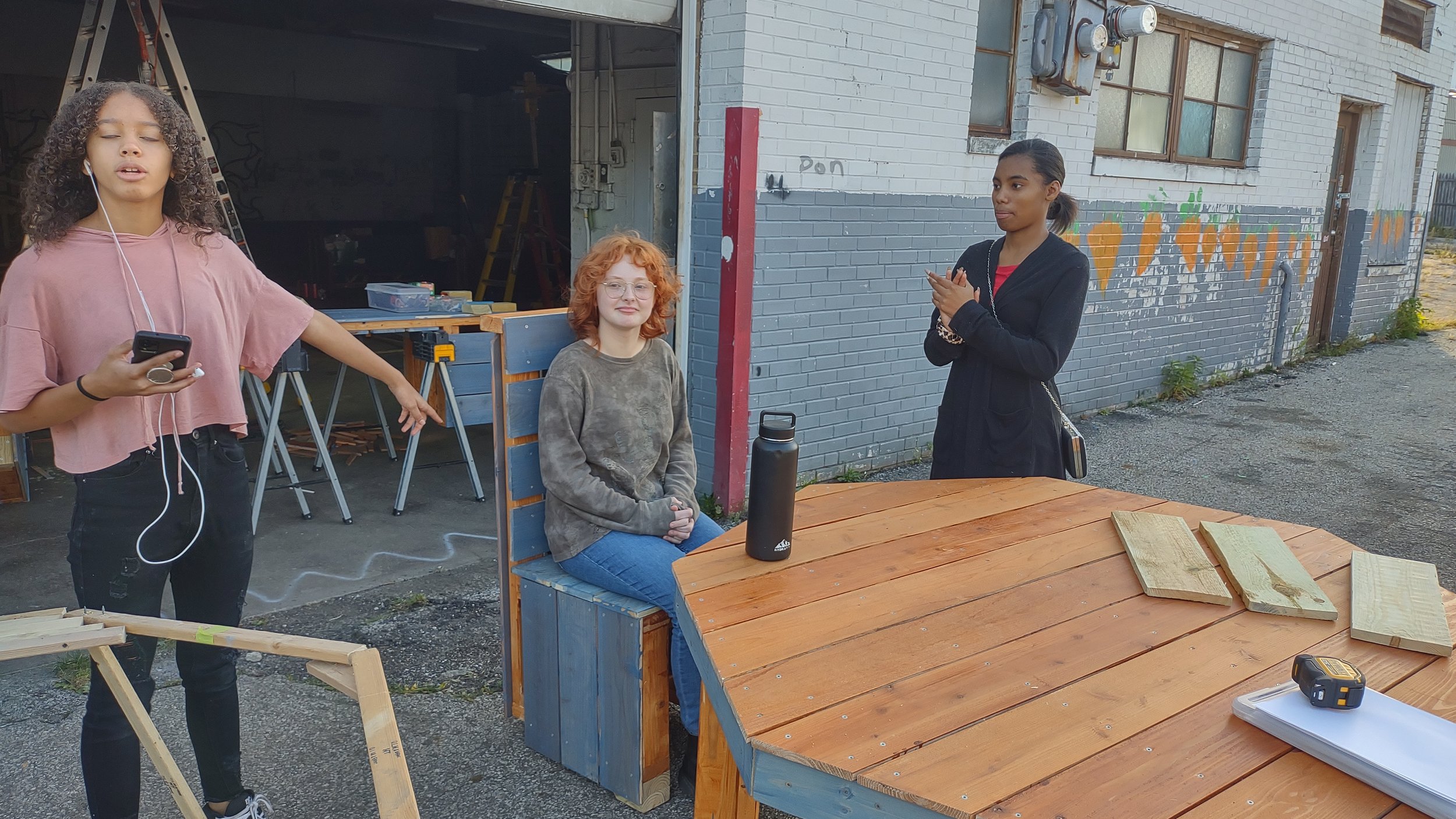
MOOS construction site: “The Junkyard” in Old Brooklyn
Building on the MOOS initiative, the CUDC received a $30,000 grant from the National Endowment for the Arts (NEA) to support a new MOOS initiative. This grant is one of 1,251 Grants for Arts Projects awards totaling nearly $28.8 million that were announced by the NEA as part of its first round of Fiscal Year 2023 grants.
“The National Endowment for the Arts is proud to support arts projects in communities nationwide,” said NEA Chair Maria Rosario Jackson, Ph.D. “Projects such as this one with Kent State University’s Cleveland Urban Design Collaborative strengthen arts and cultural ecosystems, provide equitable opportunities for arts participation and practice, and contribute to the health of our communities and our economy.”
The new NEA grant is being used to will support the work of middle and high school students as they design and fabricate a public space installation in Cleveland’s Brighton Park. Brighton Park is a new public space that Cleveland Metroparks, the Western Reserve Land Conservancy and the Old Brooklyn Community Development Corp. created in 2021 from a former landfill in the heart of the neighborhood.

Brighton Park (Cleveland Metroparks/Kyle Lanzar)
The broader benefits of this project include new ways of seeing and designing public spaces through the eyes of teenagers who navigate and inhabit these spaces. This project celebrates America’s creativity and cultural heritage by encouraging youth to engage in their local community, combining their embodied knowledge of this place with the conversations they have and the discoveries they make through MOOS. Their design ideas will directly benefit their friends, families and neighbors.

Data artist Jer Thorp
Grant funds will be used to engage nationally recognized data artist Jer Thorp in a collaborative project with MOOS students. Jer teaches at New York University. He was formerly the Data Artist in Residence at the New York Times and at National Geographic. Jer and the CUDC’s MOOS Coordinator Ben Herring will work with MOOS students to create a data installation in Brighton Park. Jer will be in Cleveland in September to explore some initial ideas with the students. He’ll return later this fall to work with students on the installation. There will be a public event to share the MOOS work with the community.
The project will invite an intergenerational dialogue that fosters a mutual respect for diverse beliefs and values among Cleveland youth, professional designers and community members of all ages.
For more information about MOOS, visit www.wearemoos.org or contact cudc@kent.edu.

Inclusivity Matters: Elevating Voices in the Anthology of Blackness

Access the recording of the session here.
Join us Thursday, November 9th at 5:30 pm for a lecture, reception, and book signing with Professor Omari Souza.
In-person event at Third Space Action Lab, 1464 E 105th Street in Cleveland, Ohio with Zoom Livestream
Please register for the in-person event, which is free and open to the public.
The event is co-hosted by the CUDC and Third Space Action Lab with support from Kent State University’s College of Architecture and Environmental Design and the Cleveland Foundation.
The lecture/book talk will begin at 5:30pm, followed by a reception and book release event for An Anthology of Blackness, The State of Black Design. The Anthology is an adventurous collection that examines how the design field has consistently failed to attract and support Black professionals—and how to create an anti-racist, pro-Black design industry instead. Third Space Reading Room will have copies of the book available for purchase.
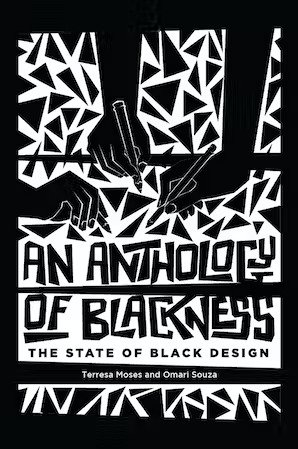
Book cover for An Anthology of Blackness
An Anthology of Blackness examines the intersection of Black identity and practice, probing why the design field has failed to attract Black professionals, how Eurocentric hegemony impacts Black professionals, and how Black designers can create an anti-racist design industry. Contributing authors and creators demonstrate how to develop a pro-Black design practice of inclusivity, including Black representation in designed media, anti-racist pedagogy, and radical self-care. Through autoethnography, lived experience, scholarship, and applied research, these contributors share proven methods for creating an anti-racist and inclusive design practice.
In an era marked by an alarming surge of anti-DEI (Diversity, Equity, and Inclusion) bills across nearly half of the United States, the urgency of works like The Anthology of Blackness shines brighter than ever. As these bills threaten to undermine the hard-fought progress toward inclusivity, the imperative to provide a platform for historically marginalized voices becomes resoundingly clear. At a time when the design industry is engaged in a dynamic struggle to embrace multifaceted diversity, the resonance of these narratives becomes a potent tool for inspiring collective resilience and progress.

Speaker, designer, and author Omari Souza seated in a library
Omari Souza is an accomplished Assistant Professor of Communication Design at the University of North Texas. With a diverse background and wealth of experience, he has made significant contributions to various industries and academic institutions. Omari's journey as a first-generation American began in the vibrant borough of the Bronx, New York. His cultural heritage traces back to his Jamaican roots, adding a unique perspective to his work and worldview. Before his academic career, Omari held pivotal roles at esteemed organizations such as VIBE magazine, Capital One, CBS Radio, and Case Western Reserve University. These experiences gave him invaluable insights into media, broadcasting, and higher education.
Omari co-hosts the highly acclaimed podcast, The Design of Business | The Business of Design minisode. This engaging platform delves into the intricate workings of design within complex organizations, influencing decisions, products, and more. As a co-host, Omari brings together industry experts and designers from diverse fields to explore the impact of design on various aspects of business. Recognizing the importance of representation and inclusivity in design, Omari is the visionary founder of the State of Black Design conference. This groundbreaking conference aims to celebrate, promote, and amplify the voices and contributions of Black designers, fostering a more equitable and diverse design industry.
In his research pursuits, Omari focuses on methods of decolonizing design practices and conducting ethical research. His exploration of these critical areas challenges existing norms and strives to create a more inclusive and responsible design landscape. With his multifaceted background, Omari Souza brings a wealth of knowledge, passion, and a commitment to positive change in communication design. His contributions and insights continue to shape the industry and inspire the next generation of designers.
One AICP Certification Maintenance credit is available for this session.