Cafe Society: A Common Ground Event

Please join us on Friday, July 30th from 5-7pm for Café Society, a Common Ground conversation about accessibility, inclusion, and community life.
Meet at Invigorate Gallery, 6500 Hough Avenue, Cleveland, Ohio.
5pm - Reception & Neighborhood walks | 6pm - Common Ground conversation
Light refreshments provided. All are welcome!
The Cleveland Foundation’s Common Ground initiative is a celebration of community-led conversation. The foundation and its community partners build this event each year to showcase the many Greater Clevelanders who want to bring people together in a unique way to build community.
This Common Ground event is inspired by Café Society. In 1938, Barney Josephson created the Café Society nightclub in New York City to showcase African American talent and to be an American version of the political cabarets he had seen in Europe. Cafe Society was the first racially integrated night club in the United States. Advertised as The Wrong Place for the Right People, Café Society welcomed everyone.
Café Society is hosted by Invigorate Gallery, Barrier-free Cleveland, Jikoo Smart Park Network, and Kent State University’s Cleveland Urban Design Collaborative, in partnership with Chateau Hough, League Park, the Heritage Baseball Museum, and Maximum Accessible Housing of Ohio.

Invigorate Gallery, 6500 Hough Avenue, Cleveland
Registration is requested. REGISTER HERE
The event will be held outdoors. For more information and to discuss accessibility needs, please email barrierfreecle@kent.edu or call the Cleveland Urban Design Collaborative at 216.357.3426.
Employment Opportunities at the CUDC

The CUDC is hiring. We are seeking applicants with urban design experience, an interest in design education, and a commitment to public involvement in design processes.
We currently have two open positions: Senior Urban Designer (Position 987750) and Urban Designer (Position 987671). Both positions are based at the CUDC in Downtown Cleveland. Application deadline is August 13, 2021.
Please apply through Kent State University’s jobs portal.
Climate Change Scenarios in the Great Lakes
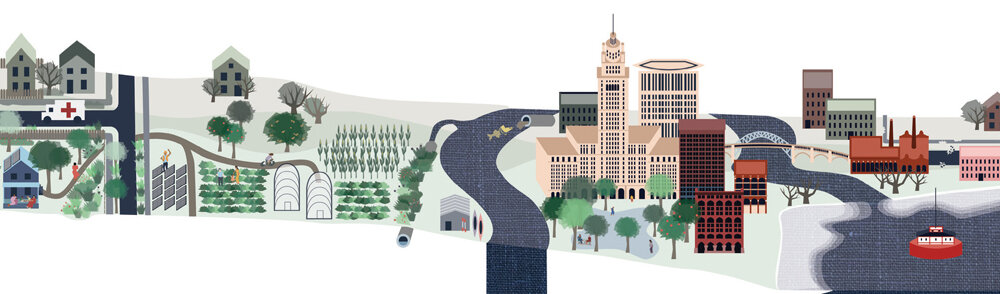
As wildfires spread on the west coast, hurricanes and rising sea levels batter cities on the east coast and in the south, and sunbelt cities struggle with droughts, those of us fortunate to live in the Great Lakes region watch and wonder if a rediscovery of legacy cities in the Rustbelt is at hand.
Cleveland, Ohio had over 900,000 residents in 1950. Today, the city’s population is less than 400,000. The populations of many cities, large and small, in the Great Lakes region have followed a similar trajectory, for the same reasons--globalization, deindustrialization, and suburbanization.
And yet, the fundamental reasons for why cities historically located on the shores of the Great Lakes remain true today. A central location, an interconnected network of road, rail, and energy infrastructure, and access to the largest freshwater system on earth provide a compelling basis for the re-urbanization of a megaregion that could support many more people and industries than exist here today.
The CUDC is one of seven organizations nationwide selected to receive a grant from the Lincoln Institute of Land Policy to explore scenario planning strategies. Our project envisions the possibilities for resilient and climate-responsive regrowth in Great Lakes cities.
The CUDC and architect/climate scientist Nick Rajkovich will collaborate on a community-focused how-to guide for scenario planning for climate resilience in the lower Great Lakes region. The guide will draw on our experience working with frontline community organizations in Northeast Ohio and Western New York on climate change mitigation, adaptation, and resilience issues.

Buffalo, New York from Lake Erie
The cities of Cleveland, Buffalo, Toledo, Detroit, and Erie share an industrial history that drove economic growth in the 19th and early 20th centuries, followed by decades of depopulation, disinvestment, and decline. As sea level rise, hurricanes, and other natural disasters begin to destabilize coastal areas, the Great Lakes region is could become a climate refuge in the future.
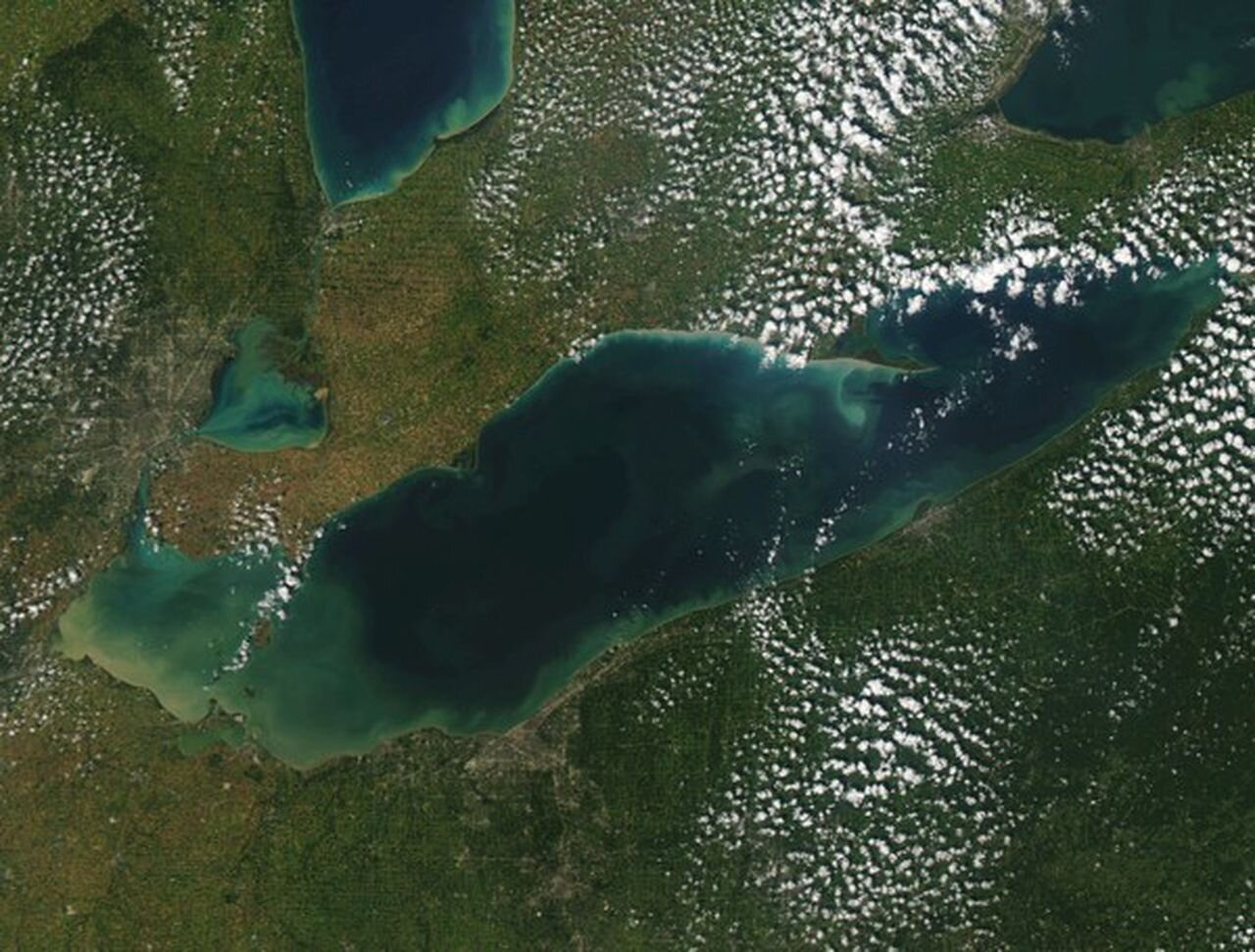
NASA/NOAA
Cities on Lakes Erie and Ontario have a moderate climate and abundant access to fresh water. However, these cities face numerous other challenges that put environmental and human health at risk: an increase in temperature extremes, more intense winter and summer storms, and increased flooding risks. Compounding the problem, high percentages of impervious land cover, sparse tree canopy, and aging infrastructure compound the risk in low income and minority communities.
How should cities in the Lower Great Lakes plan for the future? We will be creating a how-to guide for making climate-responsive land use decisions in older industrial cities and regions, exploring populations gains and losses, scenarios about where to focus redevelopment and where to protect land for habitat and green infrastructure. Drawing on our experience working in Northeast Ohio and Western New York, the guide will show how scenario planning can help communities determine how to best manage their vacant land inventories to support new development while buffering residents and businesses from the adverse impacts of climate variability and change.
The project is currently underway and will be completed in 12 months. For more information, please contact the CUDC at cudc@kent.edu or 216.357.3434.
Making Our Own Space in Your Community

HEY! Kent State University’s Cleveland Urban Design Collaborative (CUDC) is looking for a community development corporation, government agency, or non-profit organization that serves middle and high school students within the City of Cleveland to be our partner on a new initiative in our award-winning Making Our Own Space program.
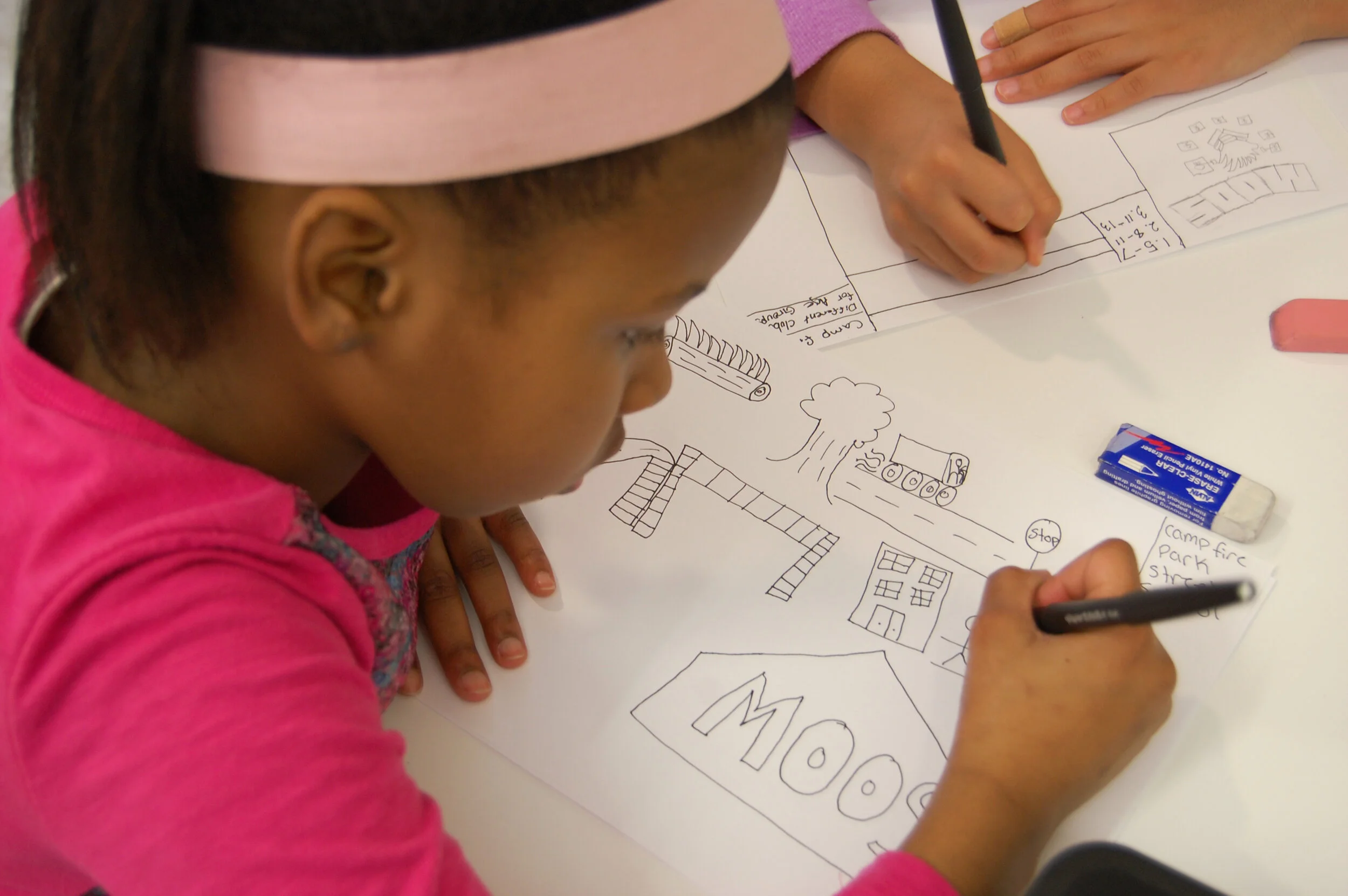
Making Our Own Space (MOOS) is a design/build program where young people imagine, design, and build improvements to public spaces in their neighborhoods. The program was established in 2015 and currently operates in six Cleveland neighborhoods and two first-ring suburbs.
The CUDC’s new initiative, Making Our Own Space Rapid Response Team (MOOS-RRT) is an outgrowth and expansion of the original MOOS program.
MOOS-RRT is an 18-month enrichment program for middle and high school students who have an interest in design and the desire to be active changemakers in their neighborhood. MOOS Students will learn valuable skills and have fun while earning a stipend for their participation in the program.
Student participants will conduct research and develop design-based solutions to address issues in a Cleveland neighborhood, in collaboration with the staff of Kent State University’s Cleveland Urban Design Collaborative (CUDC), guest designers, and community leaders. The program is anticipated to run from August 2021 - November 2022.
Thanks to the generous support of The Cleveland Foundation, the CUDC will operate this program at no cost to the community partner we select through a Request for Proposals.
Proposals are due June 30, 2021.
For more information, please download the RFP or contact cudc@kent.edu.
American Roundtable: In the Mahoning Valley

Brainard Rivet Company Shop Floor. Courtesy of Brainard Rivet Company, an employee-owned company
We are happy to announce the publication of In the Mahoning Valley, a report that is part of the Architectural League of New York's American Roundtable project and that members of Kent State University's Cleveland Urban Design Collaborative edited. American Roundtable is an Architectural League of New York initiative, bringing together on-the-ground perspectives on the condition of American communities and what they need to thrive going forward.
FULL REPORT: https://archleague.org/project/mahoningvalleyohio/
In this report, we present innovative new ideas being developed in the Mahoning Valley, Ohio, such as experiments in reimagining the role of rivers, health institutions, land banks, and governments in building community wealth opportunities. We share new models for community-based educational pipelines and employee-owned cooperatives trying to reimagine the economic future of the area.
Contributors:
Building a Better Warren, Charles Frederick, Helen Liggett, Roy Messing, Quilian Riano, Jennifer Roller, Terry Schwarz, and Kristen Zeiber
Editorial Team:
Chief Editor: Quilian Riano, Associate Director CUDC
Mapping/Graphics Editor: Kristen Zeiber, Project Manager, CUDC
Photography and Editorial Contributor: Katie Slusher, Urban Designer, CUDC
Photography and Editorial Support: Kaitlyn Boniecki, Student Employee, CUDC
This presentation and discussion, captured in the video above, complements the report In the Mahoning Valley on Youngstown, Warren, Lordstown, and other communities along Ohio’s Mahoning River. Report editors Quilian Riano and Kristen Zeiber and report contributors Helen Liggett, Gary Honeywood, and Matt Martin shared findings and highlights and then discussed some of the report’s key ideas and provocations with American Roundtable project director Nicholas Anderson and Architectural League executive director Rosalie Genevro.
New Survey: Barrier-free Cleveland

Drawing of street showing signage clearances and signal buttons for people with vision impairments
Do you or someone you know have a physical or cognitive disability, or other mobility challenges caused by aging or injuries? The Barrier-free Cleveland team would like to hear from you. We invite you to take an ONLINE SURVEY.
All survey responses are confidential. In thanks for completing the survey, you will receive a $10 Visa gift card in the mail or a $10 digital gift card from Amazon.
For more information, please call 216.357.3426 or email barrierfreecle@kent.edu.
SURVEY: MOOS Rapid Response Team
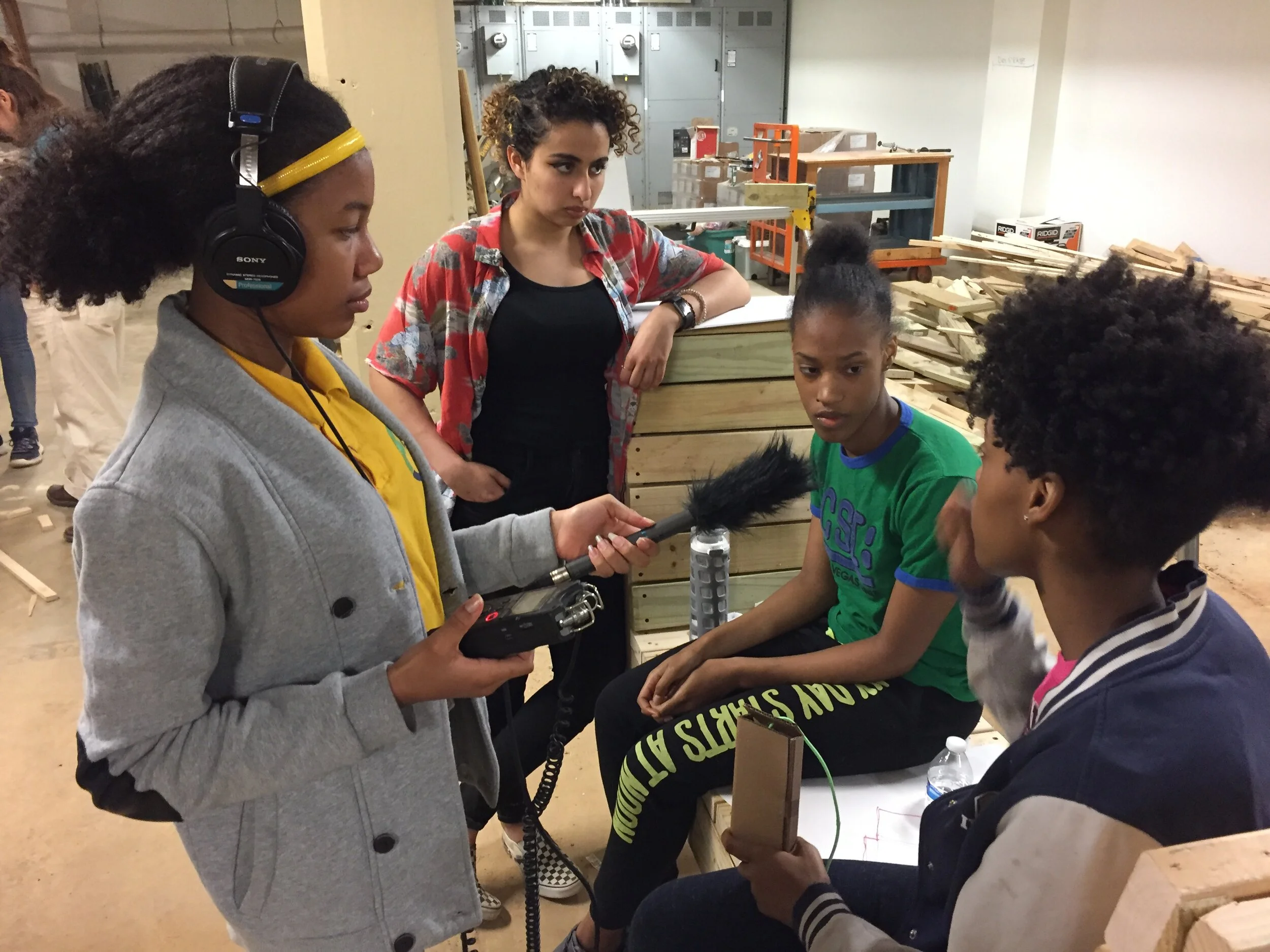
Making Our Own Space is a program of Kent State University’s Cleveland Urban Design Collaborative that engages and empowers middle school and high school students with skills to transform public spaces in their neighborhoods. With generous support from the Cleveland Foundation, the CUDC is launching a new MOOS Rapid Response Team and we’d like your input as this program takes shape.

After six years of designing and building public space improvements with young people and the completion of a strategic planning process for the program last year, we are excited to begin expanding and evolving the work of MOOS. The MOOS Rapid Response Team will build on existing partnerships in many of the neighborhoods we’ve been working in. We are also seeking a new community partner for MOOS.
The MOOS Rapid Response Team will be small but mighty, working closely with CUDC staff as urban researchers tackling questions relevant to their community. While we will still pull out the drills and chop saws for construction projects on occasion, we will also expand the design tools students use to think spatially and respond to the challenges and opportunities of their neighborhoods. This first MOOS-RRT program will run for 18 months starting in August 2021 with a group of eight students ages 13-18. Students will be paid a stipend for their leadership and creative work in the program.
In May 2021, we will issue a Request for Proposals and invite community organizations to apply to bring the MOOS-RRT program to their neighborhood. Please help us shape this RFP by completing a short survey to share your thoughts on what issues are most important in Cleveland neighborhoods right now.

If you or someone you know is affiliated with a youth-serving organization in the City of Cleveland and would be interested in collaborating on this project, please include contact info in your survey response so we can follow up.
ASLA Ohio Award for Making Our Own Space

Making Our Own Space (MOOS) received a 2020 Ohio Landscape Architecture Award for community outreach, equity, and engagement.
MOOS focuses on building awareness of design professions in historically underserved and under-represented communities. MOOS students design, construct, and install placemaking features in shared neighborhood spaces. MOOS expands awareness of landscape architecture, creates relationships between practitioners and students, and presents a path to design professions.

MOOS students learn about the actions and connections required to make real changes in their neighborhoods, through public engagement and a range of design careers. Students receive a stipend for participating to honor the value of the local knowledge, creative energy, and design work they contribute to MOOS projects. Students from the Buckeye, Detroit-Shoreway, Glenville, Clark-Fulton neighborhoods in Cleveland, and from Shaker Heights have participated in MOOS over the program’s five-year history.
Thanks to the Ohio ASLA for recognizing the MOOS program with this honor!
Spring 2021 Programs
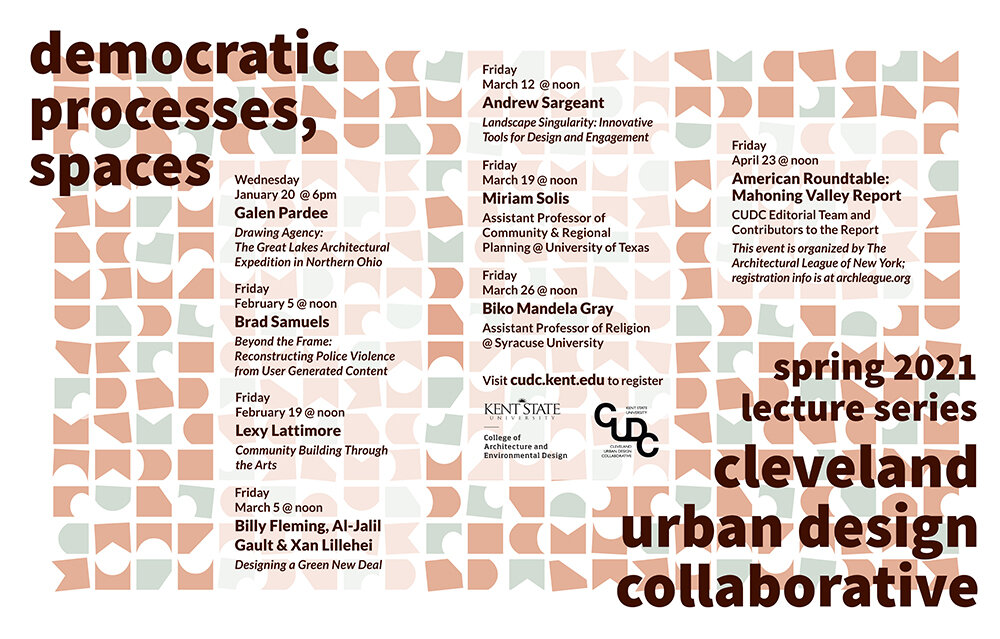
VIDEOS OF LECTURES
Brad Samuels
Beyond The Frame: Reconstructing Police ViolenceLexy Lattimore
Community Building Through the ArtsBilly Fleming, Al-Jalil Gault & Xan Lillehei
Designing the Green New DealAndrew Sargeant
Landscape Singularity Innovative Tools for Design and EngagementMiriam Solis
Equity Ecosystems: The Role Of Organizational Change In Advancing Racial Equity Through Climate Mitigation PlansBiko Mandela Gray
More in Store: Alton Sterling, Black Churches, and The Transformation of Space
Beyond the Frame: Reconstructing Police Violence from User Generated Content
Beyond the Frame: Reconstructing Police Violence from User Generated Content
Presentation by Brad Samuels
Friday, February 5, 2021 from noon-1pm
RSVP for ZOOM link

Since the late spring, SITU Research has been conducting visual investigations of protests from across the United States. This growing library of examples documents the breadth and depth of police violence and excessive use of force against protestors in its systemic context. The work leverages the extensive, publicly available, citizen documentation of each event and merges it with digital reconstruction techniques to isolate and analyze key interactions between law enforcement and civilians from multiple perspectives and crucial spatial contexts. This presentation will feature how these reconstructions serve as vehicles for accountability in the presentation of two cases: evidentiary material in a lawsuit against the Portland Police Bureau, and as an advocacy tool in a report against the New York Police Department.
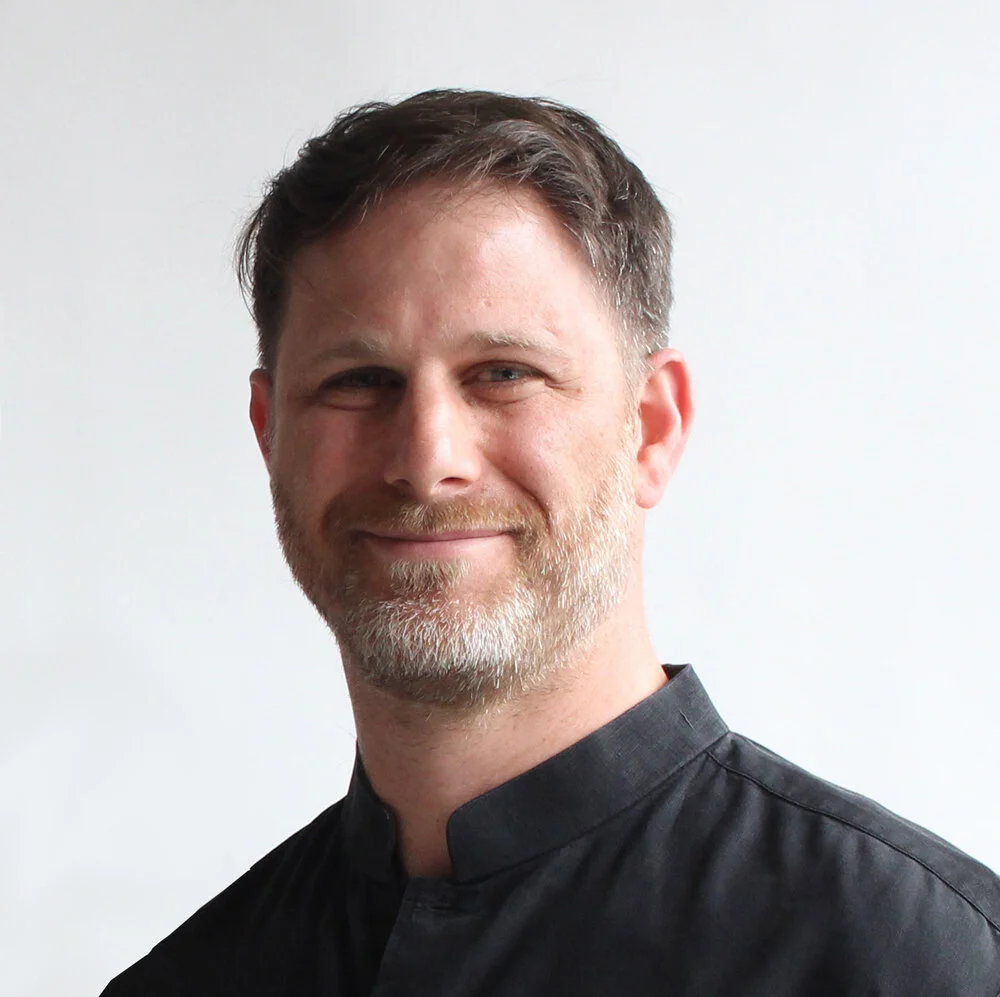
Brad Samuels is a founding partner at SITU and the Director of SITU Research—an organization that merges data and design to create new pathways for justice. Outside the multidisciplinary practice, Brad sits on the Technology Advisory Board for the International Criminal Court and the Board of The Architectural League of New York, is a Fellow with the Urban Design Forum and teaches in Barnard College and Columbia University’s undergraduate architecture program
Planning Ironies of 2020

2020 carried a heavy symbolic weight. In the preceding years, communities across the country developed 2020 plans, linking local aspirations with a magical number intended to convey clear vision.
And then 2020 arrived, bringing a pandemic, a national awakening toward racial justice, political unrest, job losses, a roller coaster economy—conditions that even those with 20/20 vision didn’t see coming.
The mismatch between 2020 visions and 2020 reality underscores the limitations of long-range planning. The future is uncertain, unsettling, downright weird. So what’s a planner to do?
First, we should retire the famous admonition from Daniel Burnham to Make No Little Plans. Because little plans are a sensible response in times of rapid change, while grand plans tend to gloss over a host of inconvenient factors that we can neither predict nor control. An important lesson of 2020 is that, while we need to remain clear in our vision and intent, we should also stay light on our feet and ready to respond to whatever challenges and discoveries the new year brings.
If the first week of 2021 is any indication, we’re in for more surprises from a changing climate, an unstable democracy, an unresolved pandemic…and adversities we have yet to imagine. Hard work, hopefulness, and a creative, incremental approach are (perhaps) the tools that will carry us through.
From all of us at the CUDC, wishing you a healthy, happy, and righteous new year.
The Great Lakes Architectural Expedition

CUDC Gallery | College of Architecture and Environmental Design, Kent State University | 1309 Euclid Avenue, Suite 200, Cleveland, Ohio
Virtual Lecture and Opening Galen Pardee, Drawing Agency: The Great Lakes Architectural Expedition in Northern Ohio, January 20, 2020 at 6 pm.
Exhibition Galen Pardee, The Great Lakes Architectural Expedition, January 20 - February 26, 2021
Free and open to the public on Mondays, Wednesdays, and Fridays from 9am - noon or by appointment. Viewing hours are subject to change. Please call 216.357.3434 or email cudc@kent.edu to confirm.
Virtual Visit Tour the exhibition here

Photo credit: Stephen Takacs
The Great Lakes Architectural Expedition, created by Galen Pardee, explores early work of the titular Expedition, a public architecture office with Lake Erie as a client. Focusing on attempts to establish their roles as public advocates and draft the contours of non-human architect-client relationships, works on display include furniture at the Parliament for a Material World, prototypes for the Maumee Basin Phosphorous Co-Op, and models of the Last Impervious Surface in Portage County Ohio.
On December 8th, 2008, the States and Territories of Illinois, Indiana, Michigan, Minnesota, New York, Ohio, Pennsylvania, Wisconsin, Montreal, and Quebec, signed into law the Great Lakes-St. Lawrence River Basin Water Resources Compact [The Great Lakes Compact], prohibiting water removal outside the Lakes’ drainage basins and creating a sealed eco-political zone within the United States and Canada. On April 25th 2018, Wisconsin approved Foxconn’s request to withdraw seven million gallons of Lake Michigan water per day for a private LCD panel factory outside Racine: Foxconn claimed its factory’s water consumption a “public use” to skirt full Compact review. This feat of semantics exposed the Compact’s lack of actionable public water definitions, and created a leak in the Compact’s closed loop.
Finally, on February 26th, 2019, the citizens of Toledo, Ohio approved the Lake Erie Bill of Rights, granting the city legal guardianship of the Lake and its’ watershed. Unchecked agricultural runoff in 2014 had rendered Lake Erie’s water undrinkable for half a million people for days at a time: algal blooms would return regardless in July 2019. These three events inspired the foundation of the Great Lakes Architectural Expedition, an experimental public architecture office entrusted with protecting the spirit of the Great Lakes Compact, researching and designing the Watershed’s public realm, and advocating for the Compact’s human, non-human, and material subjects.
The Expedition’s mission has prompted a fundamental re-thinking of architecture’s role in the Great Lakes Megalopolis—engaging legal and physical terrains with equal dexterity, expanding architectural practice with non-human client structures, and transforming architects into agents for public materials in a world of increasing scarcity. Using archival models, drawings, documents, and studies, this rare glimpse into the office’s archives explores the organizational structure of the Great Lakes Architectural Expedition itself, as well as early attempts by the Expedition’s Lake Erie Board to establish their roles as public advocates and draft the contours of non-human architect-client relationships.

Galen Pardee LeFevre Emerging Practitioner Fellow at The Ohio State University.
Galen Pardee is a designer, educator, and researcher; currently the LeFevre Emerging Practitioner Fellow at The Ohio State University. He received his BA from Brandeis University and an MArch from Columbia University Graduate School of Architecture, Planning and Preservation (GSAPP). Galen has taught at Columbia University and Ohio State, and designed projects in New York City and California. His studio Drawing Agency explores dimensions of architectural advocacy, material economy, and expanded practice. His research projects have been funded by The Ohio State University, Columbia University GSAPP, and the Graham Foundation; and published in the Avery Review and FAKTUR, among others.
Cleveland Metroparks: 2020 Urban Design Charrette

On October 2-5 the CUDC staff and ten Kent State CAED graduate students spent a full weekend in our own backyard, examining the Cleveland Metroparks sites of Brookside Reservation and the nearby Brighton Park and proposing design ideas for our parks & public spaces during a global pandemic.


After an outdoor site tour with the Metroparks, Western Reserve Land Conservancy, Big Creek Connects, and the City of Cleveland, the team got to work. Across the course of the weekend, the design team identified the following four goals for the project:
FLEXIBILITY: Create a toolkit of design ideas that can be deployed and reconfigured for a variety of futures
CONTINUITY: Link the Parks into a larger system, including filling “the gaps” as needed
GREENING: Extend the Parks into their neighborhoods & incorporate ecological best practices
ACCESSIBILITY: Create unique points of access, inviting exploration from a wide range of users

Brighton Park gateway concept (Kaitlyn Boniecki)

Wayfinding/public art ideas incorporating all-ages engagement (Kaitlyn Boniecki)

Neighborhood “back door” entry concept (Abby Lawless)

Brighton Park landscaping & natural play elements (Abby Lawless)

Treadway Creek Trail entry concept (Erika Chmielewski)
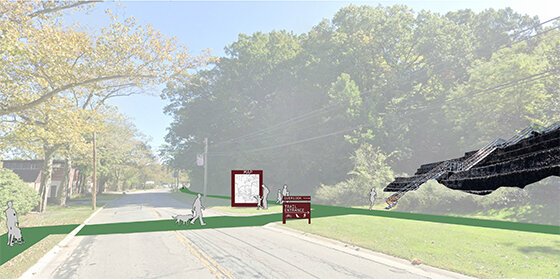
Wildlife Way/Old Brooklyn neighborhood connections (TyJuan Swanson-Sawyer)
The final work spanned terrain from the Cuyahoga River Valley via the Towpath Trail, the Old Brooklyn neighborhood, the newly-constructed Brighton Park, the Cleveland Metroparks Zoo, and the Brookside Reservation, with particular emphasis on strengthening connections from the park system to surrounding neighborhoods. Students also included considerations for neighborhood gateways, trail design, wayfinding, four-season use, pop-up programming, stormwater management, and streetscape redesign.

Pearl Rd/Brighton Park development, incorporating complete & green streetscapes (Alan O’Connell)

Stormwater management throughout Brookside Reservation (James Sasser)
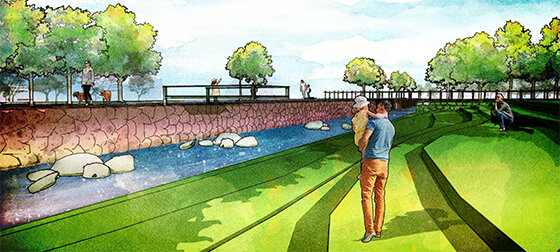
Big Creek access (James Sasser)
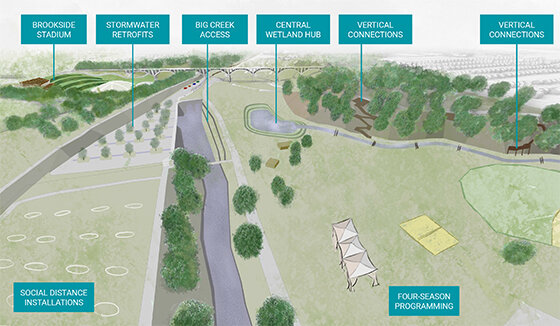
Birdseye of Brookside with final design ideas (Clayton O’Dell)
The student ideas are being compiled into a final toolkit, to be posted & distributed soon to our project website, so check back there for more soon. In the meantime, you can check out the final presentation here:
Thanks again to our partners at the Cleveland Metroparks for hosting a great charrette, and special thanks to Kent State CAED, Old Brooklyn CDC, NAIOP Northern Ohio, and Robert Mastriana/4M Company LLC for supporting the charrette. And kudos to our stalwart students for their strong & creative work!
BARRIER-FREE CLEVELAND

Barrier-free Cleveland is a new initiative aimed at eliminating barriers to everyday life for people with disabilities. The CUDC has partnered with Cleveland State University, DigitalC, and HRS Consulting on this project, with major support from The Cleveland Foundation.
61 million adults in the US live with a disability. That’s one in four people nationwide. This can include physical and mobility challenges, vision and hearing impairments, and conditions of neurodivergence, such as autism.

Source: Centers for Disease Control and Prevention
Barrier-free Cleveland will explore best practices in accessible design, assistive technologies, and programs aimed at improving access and eliminating barriers for all people. We’re taking a close look at two Cleveland neighborhoods—Clark-Fulton and Midtown/Hough. Both of these neighborhoods are developing new neighborhood plans and our goal is to align accessibilily recommendations with the priorities that emerge from these plans. This process will lead to a set of Barrier-free Cleveland guidelines for these two neighborhoods, but that also could apply to other neighborhoods in Cleveland and beyond.

The Americans with Disabilities Act was adopted by the federal government in 1990—30 years ago! Curb cuts, ramps, paratransit, and other accessibility improvements across the country came about because of this important legislation. But there is more work to do.
In 2019, the CUDC assisted North Coast Community Homes with ZeroThreshold, an international design competition for new ideas in accessible, affordable housing. The competition took a design-forward approach to accessibility, giving equal weight to aesthetics and function. Entries encompassed new construction, the retrofit of existing housing, accessible public space design, and holistic urban design strategies aimed at eliminating physical and social barriers.
Barrier-free Cleveland expands the scale from housing to neighborhoods, seeking new design approaches that enable all residents to reach neighborhood destinations, enjoy public spaces, and have full access to transit and transportation. The project team is assembling case studies from throughout the US and around the world, identifying best practices in urban design, assistive technologies, and programming to expand access for all.
We are conducting Accessibility Scavenger Hunts in the Clark-Fulton and Hough/Midtown neighborhoods in November, working with residents to identify barriers in their communities. We will also be conducting one-on-one interviews in an effort to understand the barriers to mobility that some residents face. Interviews will take place Novermber 2020 - January 2021, We will then draft a set of guidelines for addressing these barriers. The guidelines will be developed in conversation with community stakeholders and incorporated into other community planning and development efforts.

If you are interested in this work, please join us for an Accessibility Scavenger Hunt or contact us to schedule an interview. For more information, email barrierfreecle@kent.edu or call 216.357.3434.


Accessibility Scavenger Hunts
Please join Barrier-free Cleveland and Maximum Accessible Housing Ohio for two Accessibility Scavenger Hunts in November, 2020. Explore the Hough/Midtown and Clark-Fulton neighborhoodsto identify barriers and obstacles that keep people with disabilities from getting where they need to go.
The Scavenger Hunts are outdoor events, so please dress for the weather and wear comfortable shoes. Participants will look for high curbs, wide intersections, and other conditions that create barriers to personal mobility.
All participants will be entered into a drawing for a $100 Visa Gift Card. The drawings will be held at the end of November, 2020.
The first Accessibility Scavenger Hunt is in Clark-Fulton on Saturday, Novermber 14 from noon-2pm. This event is being held in conjunction with the Clark-Fulton Together Ideas + Action Week. Meet at The Yard by Funkenship, 3332 32nd Street in Cleveland, Ohio. For safety reasons the event is limited to 10 people every 30 minutes. Registration is recommended, but not required. REGISTER HERE

The second Accessibility Scavenger Hunt is in Hough/Midtown on Saturday, November 21 from 1-3pm. Meet at DigitalC, 6815 Euclid Avenue, Cleveland, Ohio. For safety reasons the event is limited to 10 people every 30 minutes. Registration is recommended, but not required. REGISTER HERE

For more information, please email barrierfreecle@kent.edu or call 216.357.3434.
Graduate Open House
October 14, 2020 at 6pm on Zoom

Register here for Zoom Link
Explore our programs:
Master of Architecture (NAAB Accredited)
Master of Science in Architecture and Environmental Design
Master of Science in Construction Management
Master of Landscape Architecture (LAAB Accredited)
Also featuring Dual Degree programs:
Master of Architecture and Master of Urban Design
Master of Architecture and Master of Business Administration
Design Charrette: PARKS IN A PANDEMIC
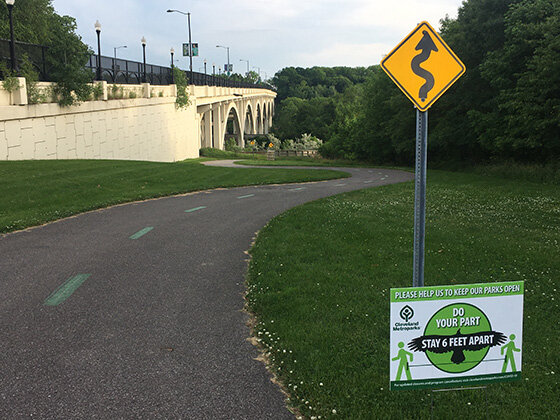
Every year, the CUDC conducts a community design charrette with graduate students from Kent State's College of Architecture and Environmental Design. The charrette is a three or four day workshop with a public sector partner to generate fresh design ideas in response to a local challenge. Typically, the charrette takes place in a community outside of Cleveland, but we can't travel this year due to COVID-19. Instead, this year's charrette will be held in Cleveland, in partnership with the Cleveland Metroparks, exploring opportunities for retrofitting public spaces to allow for social distance.
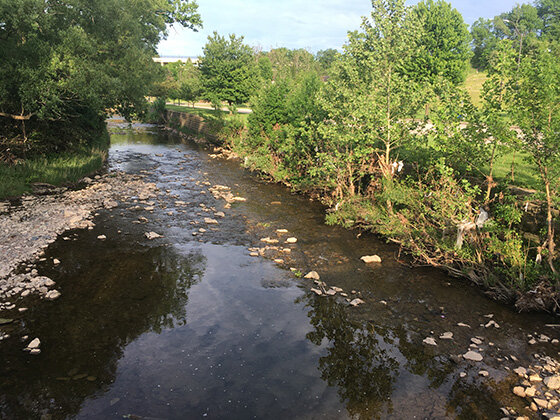
The charrette will take place from Friday, October 2nd through Sunday, October 4th with a final evening presentation on Monday, October 5th. Focusing on Brookside Reservation, located along Big Creek between the Brooklyn Centre, Stockyards, and Old Brooklyn neighborhoods, the students will generate small- and large-scale ideas and work with neighborhood partners to reimagine local park spaces.
Brookside is adjacent to the planned Brighton Park and trail extensions to the Towpath Trail - what opportunities do these larger networks bring to address social inequities and accessibility within Cleveland? In an uncertain future, how can we (re)design public spaces to be flexible and accessible, while also accommodating necessary social distance?
During the charrette weekend, we will explore the following questions:
Can public spaces be quickly retrofitted to allow for a wide range of scenarios?
How can parks allow for social interactions and attract new users, while maintaining 6’ distance?
How do pedestrians and bicyclists connect to the park system and how can the city street network facilitate these connections?
How can parks be safe places for all city residents, especially those most in need?
And how can we use this moment of fluctuating human use to emphasize and accommodate larger ecological functions?
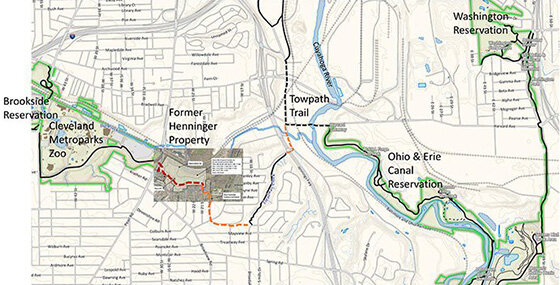
Plans to connect Brookside Reservation to the larger Towpath Trail & regional park network through the new Brighton Park
The Metroparks site and its larger neighborhood connections provide an opportunity to study Cleveland’s public spaces, and generate spatial and programmatic ideas that provide flexible alternatives for future use. Visit the Brookside2020 website for details about how to participate.
![Domino Park, Brooklyn, NY: social distancing circles. [img: Marcella Winograd]](http://static1.squarespace.com/static/56f9538fd210b8d37ef6d7a8/5f6b4071f25c692a14c4a4d1/5f6b40aaf25c692a14c4ab84/1600864426247/domino_park.jpg?format=original)
Domino Park, Brooklyn, NY: social distancing circles. [img: Marcella Winograd]
FALL 2020 PUBLIC PROGRAMMING SERIES

This Fall the CUDC is excited to continue to celebrate our 20th anniversary by holding a series of free and open tto the public virtual programs that bring local and national experts to our community. We invite you to join us for each conversation.
09/11: Mordecai Cargill, Co-Founder + Creative Director, Third Space Action Lab | VIDEO
09/18: Barbara Brown-Wilson, Associate Professor, Urban + Environmental Planning, University of Virginia | VIDEO
09/25: Jim McKnight, Senior Landscape Architect, Mayor’s Office of Capital Projects | VIDEO
10/09: Sabrina Dorsainvil, Director of Civic Design, Boston Mayor’s Office of New Urban Mechanics | VIDEO
10/16: Quardean Lewis-Allen, Founder and CEO of Made in Brownsville/ Youth Design Center | VIDEO
10/23: Nina Rappaport and Robert N. Lane, Editors of The Design of Urban Manufacturing | VIDEO COMING SOON
10/30: LAND AS RESOURCE — New Models for Thriving with the Land | VIDEO
A Conversation on The American Roundtable by teams looking at West Virginia (Merritt Chase), North Carolina, and Youngstown/Warren Ohio (CUDC). Moderated by the Architectural League of New York.
LAND AS RESOURCE: New Models for Thriving with the Land
LAND AS RESOURCE: New Models for Thriving with the Land
Conversation with American Roundtable editorial teams, moderated by Nicholas Anderson, Project Manager of the American Roundtable for the Architectural League of New York.
Friday, October 30, 2020 from noon-1pm
RSVP for ZOOM info

Across much of the United States, particularly outside of the booming metropolises of the “knowledge economy,” land is frequently a community’s most valuable asset. Historically, this has been thought of in terms of extraction: minerals to take; oil to pump; water to harness; soil to exploit. As economic forces reduce the viability of such models, and consciousness grows around the ecological fragility of our environments, how can communities reimagine land as a resource?
The editorial teams that will present will share case studies that propose new ways of thinking about land as a resource. This discussion grows from reports, commissioned by The Architectural League’s American Roundtable initiative, which seek to bring together on-the-ground perspectives on the condition of small to mid-size American communities and what they need to thrive going forward. Commissioned reports on these three locales, along with six others, will be published by The Architectural League in the coming weeks and months. Look for more information on the initiative, the reports, and additional programming here.
This session will look the Appalachia region of West Virginia, the Southeast Good Food Corridor in North Carolina, and the Mahoning Valley (Youngstown, Lordstown, and Warren) in Ohio.

Appalachia, West Virginia
Nina Chase, Editor, Merritt Chase
Appalachia Rising aims to build momentum toward an alternative land-based future for the state of West Virginia. West Virginia is defined by its land. The state’s hills, hollers, valleys, rivers, creeks, and forests have been deeply embedded in the culture of communities for generations. But the accumulated depletion of natural resources has perpetuated a cycle of boom and bust throughout the state’s history. This rhythm has left landscapes scarred, communities abandoned, and generations struggling to redefine the future. How can we build momentum for an alternative future that prioritizes the uniqueness and resilience of West Virginia’s people and places? What if the shared reverence for land is leveraged instead toward planning and designing new relationships with the state’s natural resources and natural beauty? West Virginia’s landscapes could again become the state’s greatest assets. Through the lens of the American Roundtable themes, five local contributors document the successes, failures, and opportunities of alternative West Virginia land-based ventures. These projects include new forms of infrastructure, recreational landscapes, reforestation initiatives, urban agriculture, and renovated public spaces. The landscapes imagined and the projects documented inspire a new narrative for West Virginia and a future that is even more wild and wonderful than it is today.
Nina Chase is a West Virginia native and Pittsburgh-based landscape architect. She is the co-founder of Merritt Chase.
Photo credit: Rebecca Kiger (Grow Ohio Valley, Wheeling, WV)

Along the Lumbee River, North Carolina
Joey Swerdlin, Editor + Contributor Davon Goodwin
In his contribution, Davon discusses his journey to owning and running a farm in rural North Carolina after growing up in Pittsburgh with little farming background. During this discussion, Davon will speak about his organizing and advocacy for young, black farmers and the differences between land ownership and land stewardship.
Joey Swerdlin is one of the report editors of Along the Lumbee River. Joey is an architectural designer. Currently he is a member of Group Project and the Community Director at Morpholio.
Davon Goodwin’s contribution to Along the Lumbee River is entitled “Can Two Black Millennials Come Out of College, Farm, and Get it Right?” Davon is the manager of the Sandhills Ag Innovation Center. Davon works to reinvigorate the local sustainable farm economy and support the next generation of farmers. He also owns and operates OTL Farms, a 42-acre sustainable farm located in Laurinburg, NC.

Mahoning Valley, Ohio (Youngstown-Warren-Lordstown)
Quilian Riano, Lead Editor + Matt Martin, TNP.
The physical and social landscapes of Youngstown, Warren, and Lordstown, Ohio are characterized both by the manufacturing and industrial prowess of the Mahoning Valley during the late 19th and early 20th centuries, and the steady population and job loss the region has endured since the 1970s. The report addresses the region’s changing industry, economy, and labor markets – documenting what has been lost and identifying new economic and social models that have arisen, and how these opportunities are changing the spatial and social infrastructure of the community.
Quilian Riano is Associate Director of Kent State University's Cleveland Urban Design Collaborative.
Matt Martin is the Executive Director of the Trumbull Neighborhood Partnership.
This program is free and open to the public, with support from Kent State University’s College of Architecture and Environmental Design. Certification Maintenance credits for this lecture are available, thanks to our partners at APA Ohio, Cleveland Section.


The Design of Urban Manufacturing

The Design of Urban Manufacturing
Presentation by Nina Rappaport and Robert N. Lane
Friday, October 23, 2020 from noon-1pm
RSVP for ZOOM info
Today, urban manufacturing is seen as significant however, it is poorly understood in terms of urban design, architecture, and policy. Using the most current research and case studies from around the world, authors Nina Rappaport and Rob Lane will discuss the places, spaces, and policies for the future of production in cities.
Robert N. Lane is Principal of Plan & Process LLC and is Senior Fellow for Urban Design at Regional Plan Association, where he directs the Regional Design Program, devoted to reforming the metropolitan landscape through research and place-based planning and design interventions. Industrial district design and redevelopment has been a particular area of focus for research, publications, exhibitions, and lecturing. Robert N. Lane was a Loeb Fellow at the Harvard Graduate School of Design during the 2008-2009 academic year; he was also a 2013 Fellow at the Design Trust for Public Space for the Making Midtown initiative.
Nina Rappaport is an architectural historian, curator, and educator. She focuses on industrial urbanism, infrastructure, and the role of the factory worker. She is author of Vertical Urban Factory (2015) which includes an exhibition and a think tank of the same name. She is co-editor of the Ezra Stoller: Photographer (2012) and author of Support and Resist: Structural Engineers and Design Innovation (2007). She is Publications Director at the Yale School of Architecture and was a Fellow of the Design Trust for Public Space in 2006. She is a Lecturer at the Michael Graves College of Public Architecture at Kean University, and has taught in other New York City area schools. She writes for numerous journals and lectures internationally.

This program is free and open to the public, with support from Kent State University’s College of Architecture and Environmental Design. Continuing Education and Certification Maintenance credits for this lecture are available, thanks to our partners at AIA Cleveland and APA Ohio, Cleveland Section.


