2024 Hines Student Team Receives Honorable Mention

In its 22nd year, the ULI Hines Student Competition offers graduate students a unique opportunity to tackle real-world land use challenges in North American cities. Founded by Gerald D. Hines, the competition fosters innovation and collaboration among students, highlighting the importance of multidisciplinary solutions in urban development. With over 11,000 participants worldwide since 2003, it has become a cornerstone in shaping the future of urban planning and design.
For Architecture and Urban Design students at Kent State University and Planning students at Cleveland State University, this competition is an exciting challenge. It provides students with invaluable hands-on experience, bridging academic learning with practical insights into urban development complexities. Our partnership with the Urban Land Institute further enhances our commitment to excellence in urban design and planning education, offering students access to industry expertise, mentorship, and a vast professional network.

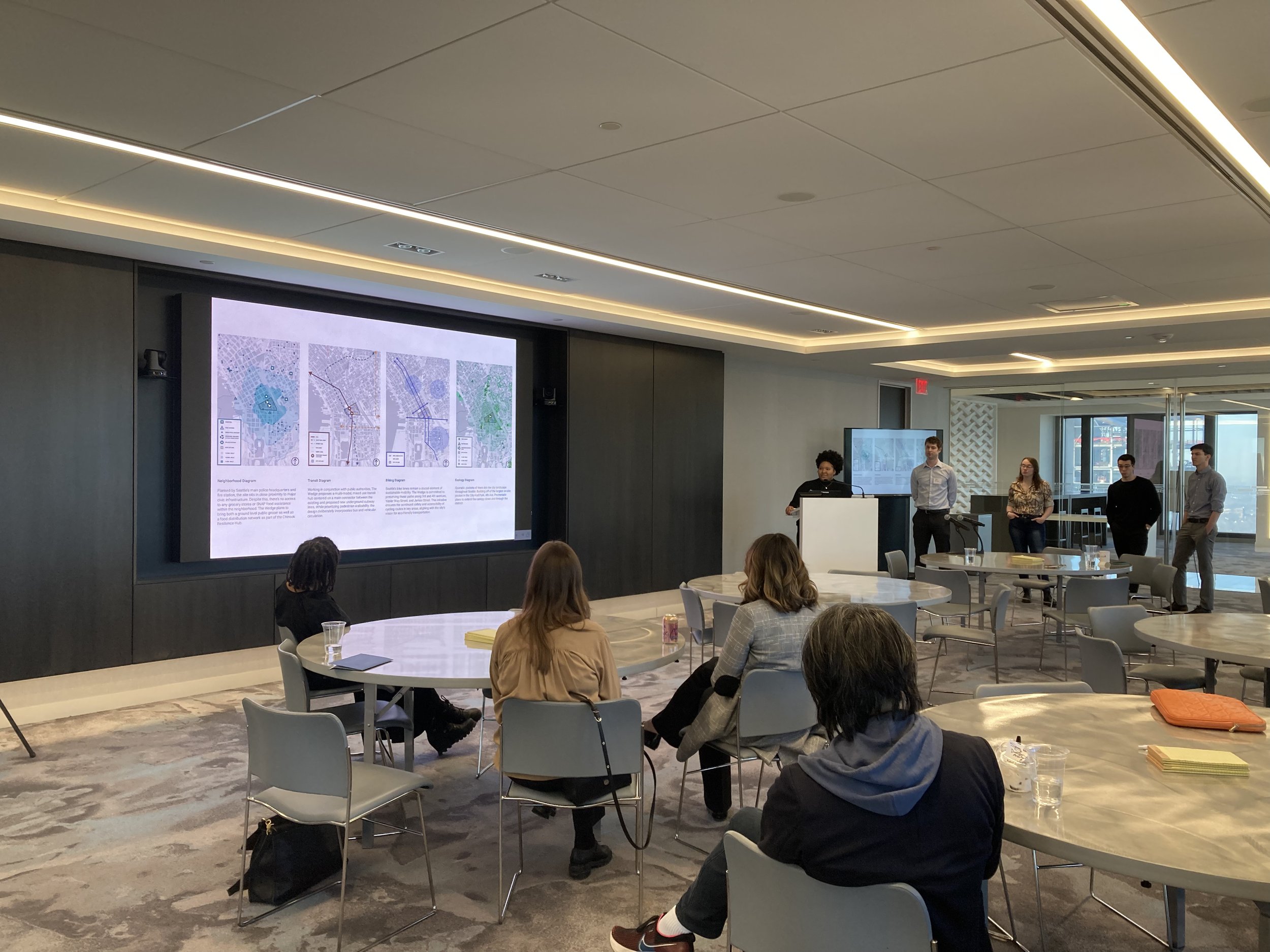
This year's challenge focuses on revitalizing a designated site in downtown Seattle, addressing real-world conditions with innovative and sustainable proposals for a vibrant, mixed-use, mixed-income neighborhood. Congratulations to Drew Thompson, Christopher Rini, Jyae McWilson, Edgardo Mcgorty, and Raz Rasmussen from Cleveland State University and Kent State University, alongside ULI Members Ken Kalynchuk and Alex Long, CSU advisor Roby Simons, and and CUDC advisors Maira Faria, Elizabeth Ellis and Terry Schwarz, for their exceptional contributions to this year's competition.
For more information: ULI CLEVELAND - 2024 Hines Student Team Receives Honorable Mention
Design Charrette: PARKS IN A PANDEMIC
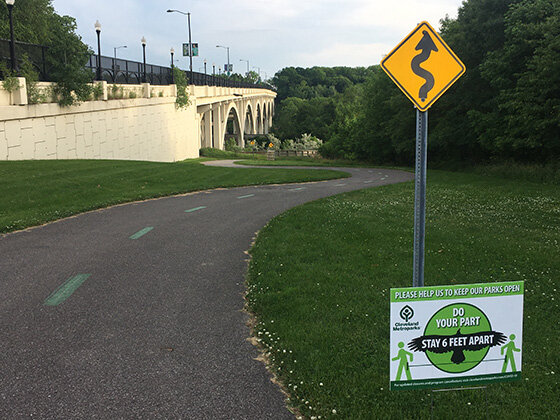
Every year, the CUDC conducts a community design charrette with graduate students from Kent State's College of Architecture and Environmental Design. The charrette is a three or four day workshop with a public sector partner to generate fresh design ideas in response to a local challenge. Typically, the charrette takes place in a community outside of Cleveland, but we can't travel this year due to COVID-19. Instead, this year's charrette will be held in Cleveland, in partnership with the Cleveland Metroparks, exploring opportunities for retrofitting public spaces to allow for social distance.
The charrette will take place from Friday, October 2nd through Sunday, October 4th with a final evening presentation on Monday, October 5th. Focusing on Brookside Reservation, located along Big Creek between the Brooklyn Centre, Stockyards, and Old Brooklyn neighborhoods, the students will generate small- and large-scale ideas and work with neighborhood partners to reimagine local park spaces.
Brookside is adjacent to the planned Brighton Park and trail extensions to the Towpath Trail - what opportunities do these larger networks bring to address social inequities and accessibility within Cleveland? In an uncertain future, how can we (re)design public spaces to be flexible and accessible, while also accommodating necessary social distance?
During the charrette weekend, we will explore the following questions:
Can public spaces be quickly retrofitted to allow for a wide range of scenarios?
How can parks allow for social interactions and attract new users, while maintaining 6’ distance?
How do pedestrians and bicyclists connect to the park system and how can the city street network facilitate these connections?
How can parks be safe places for all city residents, especially those most in need?
And how can we use this moment of fluctuating human use to emphasize and accommodate larger ecological functions?
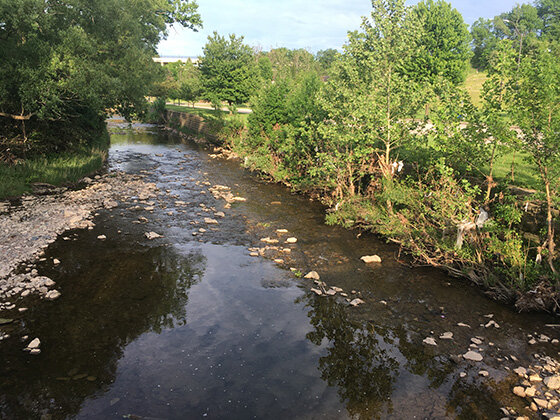
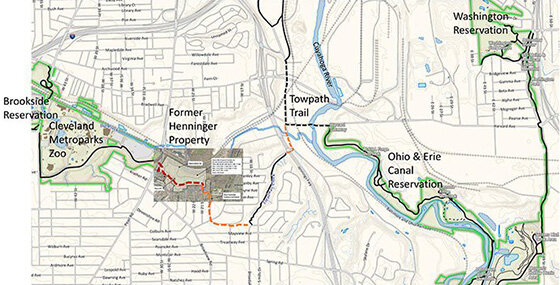
Plans to connect Brookside Reservation to the larger Towpath Trail & regional park network through the new Brighton Park
The Metroparks site and its larger neighborhood connections provide an opportunity to study Cleveland’s public spaces, and generate spatial and programmatic ideas that provide flexible alternatives for future use. Visit the Brookside2020 website for details about how to participate.
![Domino Park, Brooklyn, NY: social distancing circles. [img: Marcella Winograd]](http://static1.squarespace.com/static/56f9538fd210b8d37ef6d7a8/5f6b4071f25c692a14c4a4d1/5f6b40aaf25c692a14c4ab84/1600864426247/domino_park.jpg?format=original)
Domino Park, Brooklyn, NY: social distancing circles. [img: Marcella Winograd]
Meet the CUDC's Summer Staff
The CUDC is delighted to have two student employees working with us on a revitalization plan for Lordstown, Ohio and on youth workshops in Shaker Heights through our Making Our Own Space initiative. Kaitlyn Boniecki, a graduate student in Kent State's Master of Architecture/Master of Urban Design program is working on the Lordstown project. Victoria Clark, an undergraduate in KSU's Architecture program has been working on MOOS.

Kaitlyn Boniecki
Kaitlyn Boniecki Going into my first year as a dual Masters in Architecture and Urban Design student, I wasn’t quite sure what to expect. With a studio space housed in downtown Cleveland, I was sure that issues of density, varying levels of development, and urban sprawl would be at the forefront of most of the curriculum. Much to my surprise, theory, narrative generation, and in-depth design research was rooted in just about every course, allowing me to dabble into my passions surrounding design and what it can do for real people. The INDEX studio, which looked at both Warren/Lordstown, Ohio and Curitiba, Brazil, was ー without a doubt ー the most intense yet rewarding studio experience that I’ve been a part of. Never did I think that my decision to study architecture or urban design would lead me to researching electric vehicles and bioremediation. My proposals for both sites focused on economic re-stimulation through an ecological lens, and while both sites had some serious differences, the outcome of a multi-modal network of localized solutions stood out in both. In Warren particularly, my initial research into Opportunity Zones, brownfield remediation, and upcoming economic opportunities in electric/autonomous vehicles and clean energy led to a proposal for the “Voltage Valley Trail” that wove economy, ecology, and equity into one sinuous experience.This project fortunately served as my entry point into working with the CUDC. I believe that my work showed dedication to intensive study on issues that will be of great importance in the near future. My work this summer has focused specifically on brownfield research as it pertains to spurring economic development in Warren and Lordstown, Ohio ー allowing me to continue to study the area after looking at it during the spring semester. Brownfields, as most people could guess, are complicated properties with a lot of potential, so finding different ways to reuse them in a sustainable and economically-beneficial manner is key. I’ve been diving deep into research about the various processes of remediation, common past uses, and issues surrounding liability and funding. In addition to this investigation, I’ve also been mapping potential sites using parcel data and online real estate listings, as well as marking many important current or upcoming projects to the Warren/Lordstown area that may impact our decisions down the road. It has been really exciting to locate some useful information while still thinking about all the possibilities that may emerge during the design phase. I’m looking forward to continuing my work into the fall by focusing more on the play between economic development, environmental justice, and social equity.
Victoria Clark
Victoria Clark Hi, I am Victoria Clark, a rising senior in Kent State’s College of Architecture. This summer, I am working with the CUDC’s Making Our Own Space (MOOS) program to facilitate workshops for local youth that channel and advance students’ design skills as they positively impact public spaces in their community. The CUDC’s mission to do this type of meaningful and responsible work for the betterment of cities was something I immediately knew I wanted to learn about and engage in. With this intern opportunity, I am able to continue my design education while focusing on my interest in urban communities and exercising my passion for both teaching and serving. Although the program has been adapted for this summer’s unique circumstances, the students’ work has the potential to be especially impactful.
For the first project, students reflected personally on these uncertain times, thought critically about the needs of their neighbors, then brainstormed ways their designs could contribute. The collaborative workshop style allowed the project to evolve into a dual-purpose socially distanced seating solution and hand sanitizing station. It is so exciting to see students lean into the meaning and motivation behind a project as they bring a design to fruition with their own hands. Out of the many takeaways from the workshops, I think the most important one right now is that the students are seeing how despite being physically distant from our neighbors, we can continue to reach them and make a difference through our designs.