

Post-Graduate Fellowship at the CUDC

Are you a recent graduate with a masters degree in architecture, landscape architecture, urban design, or planning? Are you interested in community design and youth education? If so, we have great news for you! Kent State's College of Architecture and Environmental Design's Cleveland Urban Design Collaborative (CUDC) is offering a one year, full-time paid fellowship.
As a post-graduate fellow, you will be supporting the Making Our Own Space (MOOS) design/build initiative for middle- and high-school students and working on community design projects as part of the CUDC team. You will also develop a fellowship project of your choice. 10% of your work time will be devoted to your fellowship project and a modest budget will be provided.
Eligible applicants will have experience in basic carpentry and fabrication, and excellent drafting/sketching and written communication skills. You must also have completed a graduate program in architecture, urban design, landscape architecture or planning in 2021, 2022 or 2023.
For the full job description and application instructions, please visit the Kent State Human Resources site. The application deadline is May 29, 2023. For more information, contact the CUDC at cudc@kent.edu or 216.357.3434.
Kent State University is an equal opportunity, affirmative action employer committed to attaining excellence through the recruitment and retention of a diverse workforce. Women, minorities, veterans, and individuals with disabilities are encouraged to apply.
Meet the CUDC's Summer Staff
The CUDC is delighted to have two student employees working with us on a revitalization plan for Lordstown, Ohio and on youth workshops in Shaker Heights through our Making Our Own Space initiative. Kaitlyn Boniecki, a graduate student in Kent State's Master of Architecture/Master of Urban Design program is working on the Lordstown project. Victoria Clark, an undergraduate in KSU's Architecture program has been working on MOOS.

Kaitlyn Boniecki
Kaitlyn Boniecki Going into my first year as a dual Masters in Architecture and Urban Design student, I wasn’t quite sure what to expect. With a studio space housed in downtown Cleveland, I was sure that issues of density, varying levels of development, and urban sprawl would be at the forefront of most of the curriculum. Much to my surprise, theory, narrative generation, and in-depth design research was rooted in just about every course, allowing me to dabble into my passions surrounding design and what it can do for real people. The INDEX studio, which looked at both Warren/Lordstown, Ohio and Curitiba, Brazil, was ー without a doubt ー the most intense yet rewarding studio experience that I’ve been a part of. Never did I think that my decision to study architecture or urban design would lead me to researching electric vehicles and bioremediation. My proposals for both sites focused on economic re-stimulation through an ecological lens, and while both sites had some serious differences, the outcome of a multi-modal network of localized solutions stood out in both. In Warren particularly, my initial research into Opportunity Zones, brownfield remediation, and upcoming economic opportunities in electric/autonomous vehicles and clean energy led to a proposal for the “Voltage Valley Trail” that wove economy, ecology, and equity into one sinuous experience.This project fortunately served as my entry point into working with the CUDC. I believe that my work showed dedication to intensive study on issues that will be of great importance in the near future. My work this summer has focused specifically on brownfield research as it pertains to spurring economic development in Warren and Lordstown, Ohio ー allowing me to continue to study the area after looking at it during the spring semester. Brownfields, as most people could guess, are complicated properties with a lot of potential, so finding different ways to reuse them in a sustainable and economically-beneficial manner is key. I’ve been diving deep into research about the various processes of remediation, common past uses, and issues surrounding liability and funding. In addition to this investigation, I’ve also been mapping potential sites using parcel data and online real estate listings, as well as marking many important current or upcoming projects to the Warren/Lordstown area that may impact our decisions down the road. It has been really exciting to locate some useful information while still thinking about all the possibilities that may emerge during the design phase. I’m looking forward to continuing my work into the fall by focusing more on the play between economic development, environmental justice, and social equity.
Victoria Clark
Victoria Clark Hi, I am Victoria Clark, a rising senior in Kent State’s College of Architecture. This summer, I am working with the CUDC’s Making Our Own Space (MOOS) program to facilitate workshops for local youth that channel and advance students’ design skills as they positively impact public spaces in their community. The CUDC’s mission to do this type of meaningful and responsible work for the betterment of cities was something I immediately knew I wanted to learn about and engage in. With this intern opportunity, I am able to continue my design education while focusing on my interest in urban communities and exercising my passion for both teaching and serving. Although the program has been adapted for this summer’s unique circumstances, the students’ work has the potential to be especially impactful.
For the first project, students reflected personally on these uncertain times, thought critically about the needs of their neighbors, then brainstormed ways their designs could contribute. The collaborative workshop style allowed the project to evolve into a dual-purpose socially distanced seating solution and hand sanitizing station. It is so exciting to see students lean into the meaning and motivation behind a project as they bring a design to fruition with their own hands. Out of the many takeaways from the workshops, I think the most important one right now is that the students are seeing how despite being physically distant from our neighbors, we can continue to reach them and make a difference through our designs.
Making Our Own Space [at a distance]
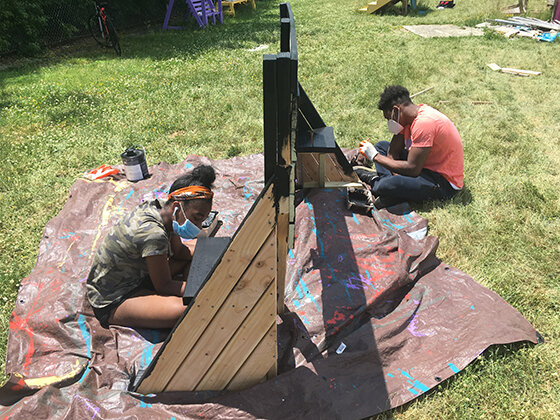
Making Our Own Space, the CUDC's design/build program for middle and high school students, continues on a limited basis this summer. Adapting MOOS for physical distancing has been a challenge, but the students at this season's first MOOS workshops in Shaker Heights rose to the occasion.Students did online design research and discussed ideas for build projects, graphics, and color schemes during remote workshop sessions. Discussions centered on the idea of how to create safe space, and how our designs can send messages to our neighbors in ways both literal and emotive. Ten students generated ideas together in a virtual setting and then split into two groups for smaller in-person workshops.

The two groups added to each other's work and built two pieces during the in-person sessions, including a 6’ long seating/signage/hand sanitizer station combo to encourage good social distancing practices, with two seats facing opposite ways on either side of the sign face and a cubby to hold a hand sanitizer bottle. Students spent lots of time developing the graphic pattern and color scheme for the side panels, but still couldn’t decide on a message for the large sign face. We will likely revisit this in August.

The other project was a free-standing sign on which that the students chose to paint a simple message of ‘HOPE.’. The students' socially distant seating piece is at the Van Aken District in Shaker Heights for the rest of the summer.

In other MOOS news, the MOOS tree house at Saint Luke's Point is complete! Two years in the making, this is one of the most ambitious and permanent MOOS projects ever constructed. Thanks to the Saint Luke's MOOS crew for your hard work and perseverance. We look forward to a MOOS tree house celebration when the pandemic has subsided and in-person events can happen again.
